


Stacker crane for high-density warehouses
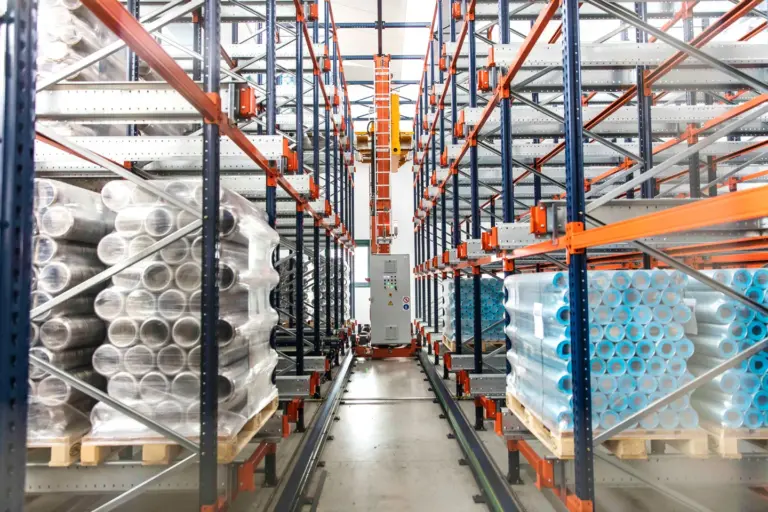
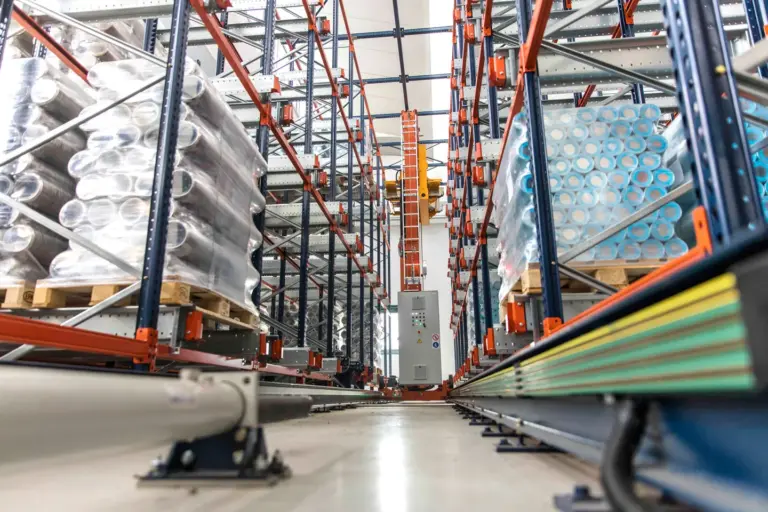
A stacker crane is an automated machine that travels on rails within a pallet racking aisle to perform pallet storage and retrieval operations. It moves along three axes: horizontally along the aisle, vertically to reach different storage levels, and in depth to position and retrieve pallets. This enables precise access to every storage location, including at considerable heights.
As the core component of an automated storage and retrieval system (AS/RS), the stacker crane is particularly suited to narrow-aisle, high-bay warehouses. Aisles can be as narrow as around 1.5 metres, while the racking can be developed vertically to maximise storage density and handling efficiency compared with conventional forklift-operated warehouses.
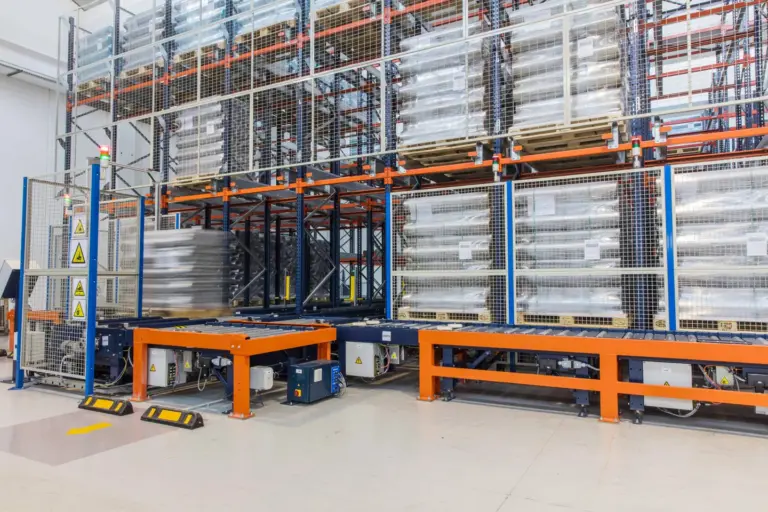
The stacker crane is controlled by warehouse management software that assigns storage locations, coordinates combined storage and retrieval cycles, and keeps inventory records continuously updated. When selecting the most suitable solution for a specific project, the racking and stacker crane must be designed as an integrated system. This ensures that the machine-to-racking interface, available storage height, load capacity and cycle times are all properly matched to the customer’s logistics flow.
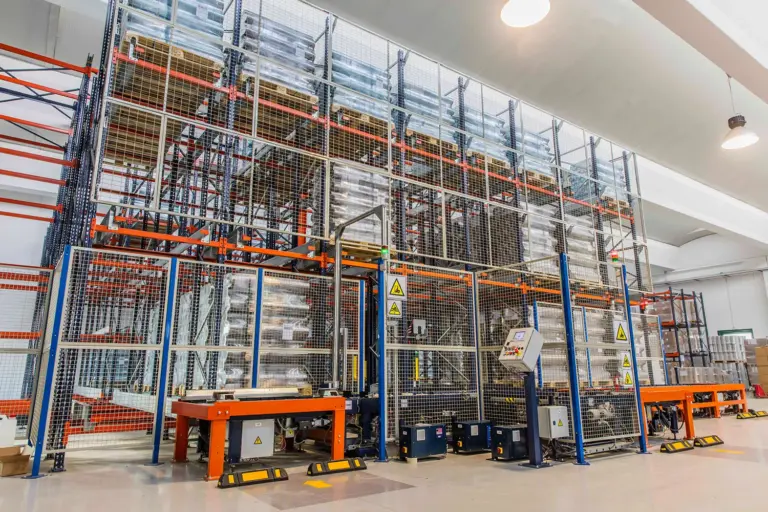
Single-mast and twin-mast stacker cranes
Pallet stacker cranes are available in two main configurations. A single-mast stacker crane has one vertical mast, with the lifting carriage and forks running along its centre. Its lighter, more compact design makes it suitable for loads of around 1,000–1,500 kg, particularly where fast cycle times and lower maintenance requirements are important.
A twin-mast stacker crane features two vertical masts connected by the lifting carriage, providing greater structural rigidity. It is typically used for loads above 2,000 kg or for bulky or non-standard load units.
Both configurations are also available as multi-aisle stacker cranes, allowing a single machine to move between aisles via a transfer bridge or switching rails. This approach reduces the number of stacker cranes required to serve multiple aisles, with a modest increase in cycle times when the machine transfers from one aisle to another.
Stacker crane technical specifications.
Stacker crane performance is determined by the design parameters of the system, which are selected according to the required throughput and the type of goods to be handled:
- Payload capacity of over 3,000 kg per load unit, with purpose-designed solutions for applications requiring higher loads.
- Lifting height of up to 40 metres, depending on the system configuration and specific installation requirements.
- Combined storage and retrieval cycles, allowing both operations to be performed in a single travel cycle and reducing non-productive travel time along the aisle.
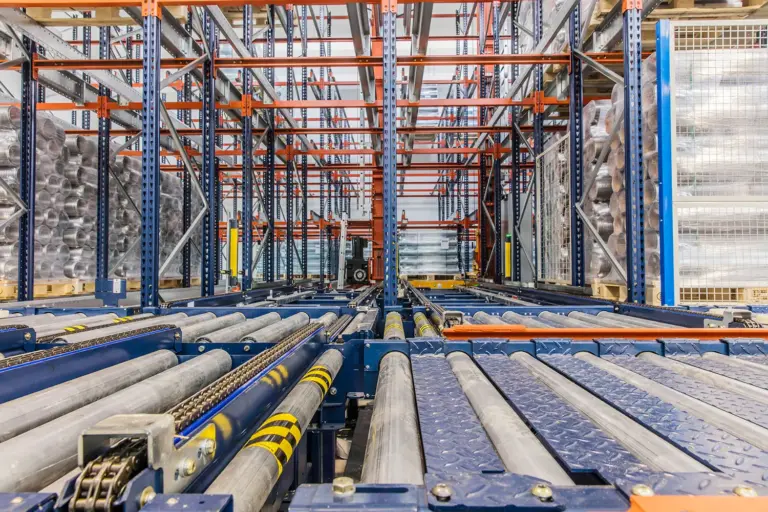
- Compatible with single and double-deep racking systems, as well as deep-lane storage systems served by radio shuttles.
- Suitable for operation in temperature-controlled environments.
This versatility allows stacker cranes to be integrated into a wide range of logistics environments, from temperature-controlled warehouses to facilities handling perishable goods, while maintaining the same operating principle and the same level of computerised control over storage locations.
Benefits of automated warehouses with stacker cranes
Integrating a stacker crane into a warehouse delivers measurable benefits across several areas of logistics operations. Automating storage and retrieval reduces the idle time associated with manual handling and enables continuous operation, increasing throughput and the warehouse’s capacity to process orders.
Computerised storage location management improves inventory accuracy by reducing picking errors and keeping stock records aligned with the goods physically stored in the warehouse. This is particularly important for businesses that require reliable batch or expiry-date traceability.
In terms of space efficiency, narrow-aisle operation and high-bay storage maximise storage density without increasing the warehouse footprint. This is particularly valuable where floor space is limited.
Stacker crane safety and applicable standards
Stacker cranes are covered by the Machinery Directive 2006/42/EC and must be designed and placed on the market in compliance with its essential health and safety requirements, including the Declaration of Conformity and CE marking. UNI EN 528 sets out the specific safety requirements for rail-mounted Storage and Retrieval Machines (SRMs), covering aspects such as structural design, stopping devices, maintenance access and interfaces with the racking system they serve.
The pallet racking served by the stacker crane is designed in accordance with the relevant standards for steel storage systems. These include UNI EN 15629, which defines the specifications for storage equipment, and UNI EN 15635, which covers the safe use and ongoing maintenance of the racking system.
It is important to note that UNI EN 15620, which covers tolerances, deflections and clearances for pallet racking, explicitly excludes the tolerances of stacker cranes and other automated handling equipment. The machine–racking interface must therefore be addressed through technical specifications established at the design stage, ensuring sufficient safety clearances for storage and retrieval operations.
In seismic areas, the structural design of the racking system served by the stacker crane must also comply with the requirements of the NTC 2018 and UNI EN 16681.
Custom design of stacker crane systems
Each stacker crane system is designed around the specific characteristics of the site, the required storage capacity, the type of load units to be handled and the cycle times dictated by the logistics flow. The design process considers factors such as available clear height, required load capacity, compatibility with the existing warehouse management system and any temperature-controlled storage requirements, allowing the racking and stacker crane configuration to be tailored to the project.
FAQ
A stacker crane is a rail-mounted machine that operates within a racking aisle and automatically performs pallet storage and retrieval without an operator on board. Unlike a forklift truck, which is manually driven and can move freely throughout the warehouse, a stacker crane follows a fixed travel path and is controlled by software that coordinates its movements. This configuration allows for narrower aisles and greater storage heights.
A single-mast stacker crane has one vertical mast and a lighter structure, making it suitable for loads of up to around 1,000–1,500 kg and generally allowing shorter cycle times. A double-mast stacker crane uses two vertical masts, providing greater structural rigidity and making it more suitable for loads above 2,000 kg or for bulky, non-standard load units.
Depending on the model and racking configuration, a pallet stacker crane can handle load capacities of over 3,000 kg per load unit and achieve lifting heights of up to 40 metres. The exact figures depend on the specific system design, the characteristics of the building and the type of load unit being handled.