


Radio shuttle racking: the semi-automated high-density storage system
Radio Shuttle racking is a high-density storage system designed for warehouses that handle large quantities of pallets per SKU while keeping operating aisles to a minimum. Unlike conventional drive-in racking, where pallets are moved entirely by forklift, Radio Shuttle systems use a motorised shuttle to handle pallet movements within the storage channels. Running along rails installed inside the racking, the shuttle moves pallets into and out of the channels based on commands from the operator.
All loading and unloading operations are carried out from the front of the racking. The forklift places the pallet at the entrance to the storage channel, where the shuttle picks it up and transports it to the appropriate available position further inside the channel. When a pallet is retrieved, the shuttle brings it back to the front, where it can be collected by the forklift. This configuration makes full use of the depth of each storage channel while keeping the forklift outside the racking.
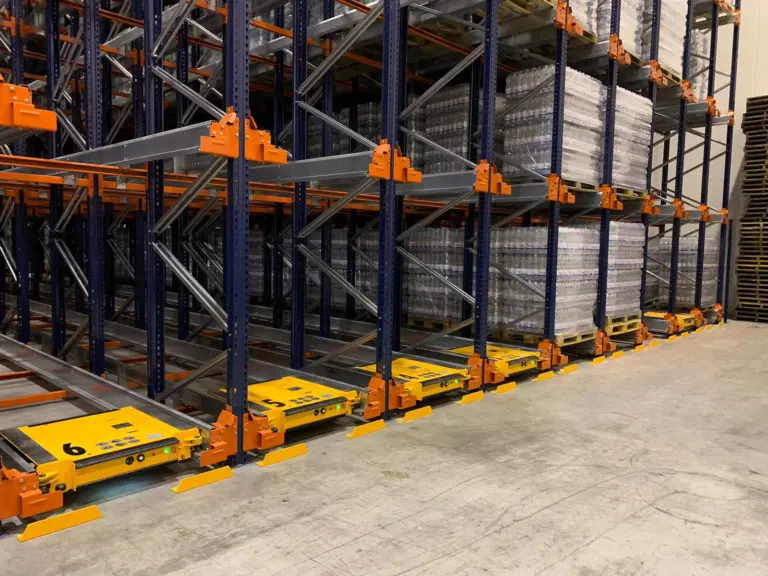
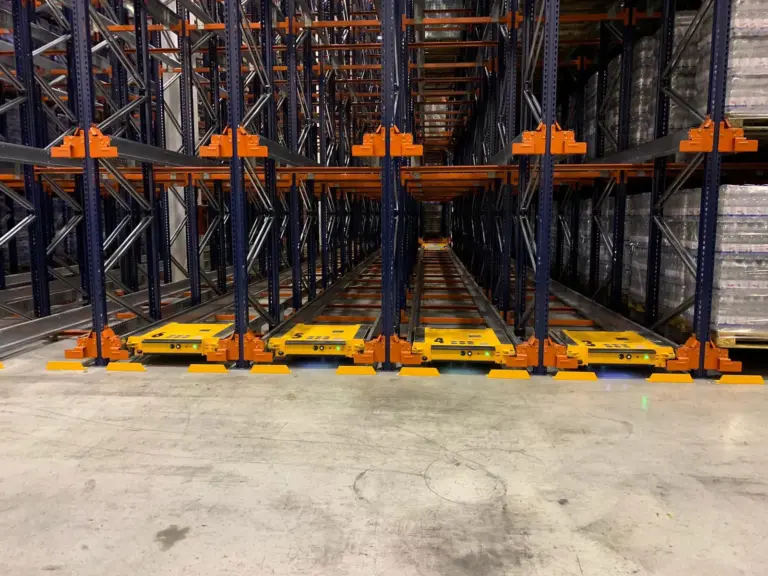
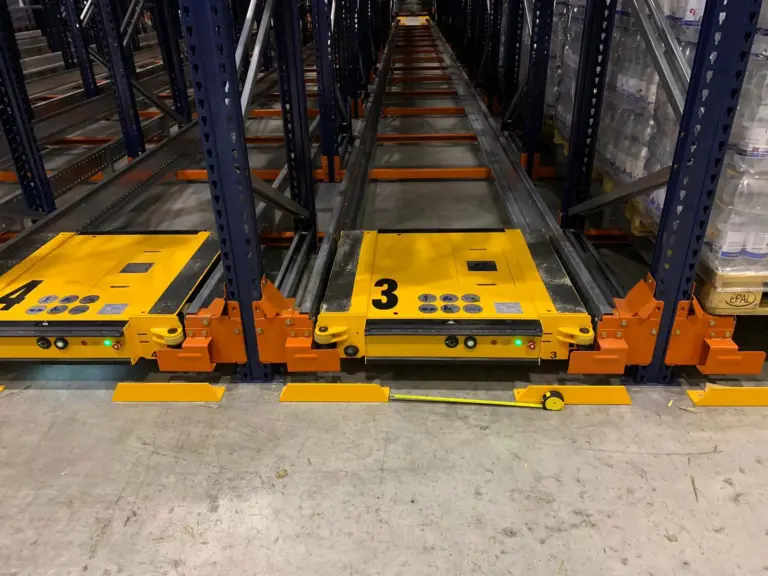
How radio shuttle racking works
Radio Shuttle racking is generally operated on a LIFO (Last In, First Out) basis, with both loading and retrieval taking place from the same end of each storage channel. Where the layout permits access from both ends, the channels can be configured for FIFO (First In, First Out) operation. This makes the system suitable for products with expiry dates or applications where stock rotation needs to be carefully controlled.
The forklift operator positions the shuttle at the entrance to the storage channel and controls it via a remote control or dedicated interface to carry out loading or retrieval operations. Once inside the channel, the shuttle moves autonomously, positioning pallets in the available storage locations and keeping track of occupied positions while providing information on the channel status.
Each storage channel can be dedicated to a single SKU. This is a key difference from conventional accumulation systems, where an entire lane is typically assigned to one SKU.
With the forklift operating only at the front of the racking, the risk of collisions with the uprights is significantly reduced, while eliminating the downtime associated with manoeuvring inside the storage channels. The shuttle also ensures consistent and repeatable pallet positioning, improving the efficiency and reliability of storage operations.
Safety and regulatory standards for radio shuttle racking systems
The motorised shuttle, together with the racking and the associated control and safety systems that make up a Radio Shuttle storage system, should not be considered an isolated component for CE conformity purposes. Where these elements are arranged and controlled to operate as an integrated whole in order to achieve a common function, the complete assembly falls within the definition of machinery under Directive 2006/42/EC.
Machine conformity must therefore be assessed for the system as a whole, including the shuttle, racking and all components involved in its safe operation. The party responsible for manufacturing or placing the complete assembly on the market must ensure compliance with the applicable essential health and safety requirements, prepare the required technical documentation, draw up the EC Declaration of Conformity and affix the CE marking.
The storage structure must also be designed in accordance with the structural requirements applicable to the specific Radio Shuttle configuration, taking into account load conditions, the interaction between the racking and the shuttle, and all relevant technical and national standards. This includes the seismic requirements set out in NTC 2018 and UNI EN 16681. These represent two distinct areas of compliance tha must be considered together when designing and implementing the system.
Benefits of radio shuttle racking
- High storage density, with greater storage capacity within the same footprint by eliminating the need for internal operating aisles.
- Ability to store a different SKU in each channel, providing greater flexibility than single-aisle accumulation systems.
- Reduced risk of structural impact, as the forklift never enters the racking.
- Reduced risk of structural impact, as the forklift never enters the racking.
- LIFO or FIFO configuration to suit the warehouse layout and stock rotation requirements.
- Maintenance can be carried out directly on the shuttle without affecting the load-bearing structure, helping to minimise system downtime.
Industries and Applications for Radio Shuttle Racking
- Food and beverage, for handling large homogeneous batches with controlled stock rotation.
- Chemical and pharmaceutical industries, where dedicated storage channels facilitate batch traceability.
- Third-party logistics (3PL) and distribution, where high volumes of pallets are handled for individual SKUs.
- Retail distribution, for central distribution warehouses with high stock turnover.
- Cold storage and temperature-controlled warehouses, where high storage density allows more goods to be stored within the same refrigerated volume.
Custom design of radio shuttle systems
Every Radio Shuttle system is designed to suit the loads to be handled, the required channel depth, the available height and the characteristics of the building. We assess the available space, operational flows and specific requirements to determine the most suitable configuration for the warehouse, taking into account both the system characteristics and the conditions in which it will operate.
The design also considers the expected loads and all applicable structural and seismic requirements. Once the system is installed, we can support the customer with technical inspections, maintenance and rack safety management, helping to ensure safe and compliant operating conditions throughout the system’s service life.
FAQ
In a Radio Shuttle system, a motorised shuttle enters the storage channel to load and retrieve pallets, while the forklift remains in the aisle. This allows for deeper stprage channels, reduces the risk of impact damage to the racking and provides greater selectivity, with each channel able to accommodate a different SKU rather than requiring an entire aisle to be dedicated to a single one.
Yes, but CE compliance does not apply to the shuttle alone. When the shuttle, racking and associated control and safety systems are integrated and operate together as a single unit to perform a specific function, the assembly falls within the definition of machinery under Directive 2006/42/EC and must undergo the relevant conformity assessment procedure and CE marking.
Channel depth varies depending on the system layout, pallet dimensions and the constraints of the warehouse. The exact capacity must be determined on a case-by-case basis following a technical assessment and verification of the expected loads.
Yes. Radio Shuttle systems are well suited to cold storage applications because reducing the number of operating aisles increases storage density, allowing more goods to be stored within the available refrigerated volume. However, the shuttle itself must be suitable for the required temperature range. This should be confirmed in the manufacturer’s technical documentation before installation.