

Push-back racking for high-density storage
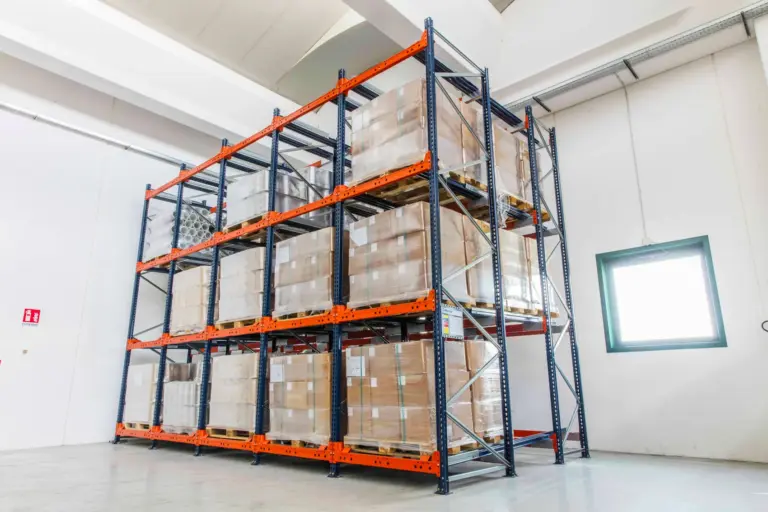
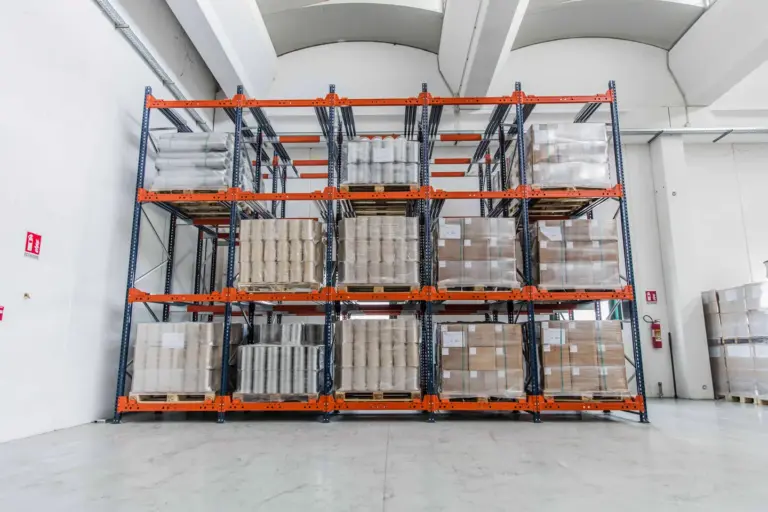
Push-back racking is a high-density storage solution designed to maximise warehouse space while providing good access to stored pallets. The system consists of slightly inclined lanes fitted with mobile carts. As each new pallet is loaded, it pushes the pallets already in the lane towards the back of the rack. During retrieval, the pallets move forward automatically towards the loading and unloading face, following a LIFO (Last In, First Out) storage principle.
We design, supply and install push-back racking systems for industrial and logistics warehouses. Each system is tailored to the load units to be stored, the available space and the customer’s operational requirements. All systems are engineered and installed in accordance with applicable technical standards and safety requirements.
How does push-back racking work?
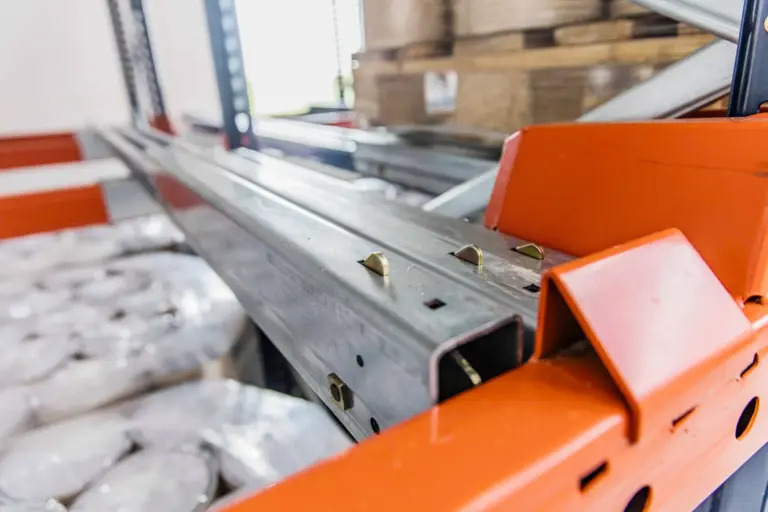
Push-back racking uses a LIFO (Last In, First Out) storage principle, whereby the last pallet loaded is the first to be retrieved. Pallets are stored several positions deep, typically up to 5–6 pallets per lane, on mobile supports such as carts or rollers running along rails with a slight incline towards the operating face.
Unlike drive-in racking, where the forklift enters the rack to load and retrieve pallets, push-back racking allows all pallet handling to be carried out from the front of the system. This means the forklift does not need to enter the rack, making loading and retrieval faster and easier to manage.
Unlike gravity flow racking, which follows a FIFO principle and typically has separate loading and unloading faces, push-back racking operates from a single face and uses a LIFO principle. It is particularly suitable for warehouses where strict stock rotation is not required, but where high-density storage needs to be combined with good selectivity. Each lane can be assigned to a specific product or load unit, allowing different types of goods to be stored within the same system.
Push-back racking design and safety
Push-back racking requires specific structural components and operating mechanisms, selected according to the characteristics of the installation and the load units to be stored. The process starts with a technical site survey to assess the available space, clear heights, pallet specifications and operating conditions. The findings are then used to define the lane configuration and rolling system, with the structure and components designed to accommodate the pallet weight and required storage capacity before installation and safety measures are carried out.
Safety is a key consideration during pallet loading and retrieval. Depending on the system configuration, push-back racking can be equipped with end stops, pallet positioning guides and load retention systems to control pallet movement and help prevent impacts or falling loads.
The use of suitable, easily inspectable components, combined with proper design and regular maintenance, helps ensure reliable, consistent operation over the long term and minimise the need for unplanned repairs.
Technical specifications of push-back racking
Push-back racking is suitable for a wide range of logistics environments and industrial applications, providing an efficient and flexible storage solution.
- Deep storage of up to 5–6 pallets per lane
- LIFO (Last In, First Out) storage principle
- Pallet loading and retrieval are carried out from a single operating face, with no need for the forklift to enter the rack. The system can be configured for single or double-depth storage, depending on the required storage density.
- Dedicated product reference for each storage lane
- Integrated safety features: end stops, pallet positioning guides and load retention systems
Benefits of push-back racking
- Maximum use of available space by reducing the number of handling aisles
- Higher storage capacity per square metre
- Ability to store different product references in each storage lane
- Faster, more streamlined pallet handling, helping improve the efficiency of warehouse operations.
- Suitable for medium and slow-moving products
- Reduced operational risks through dedicated safety features
Push-back racking tailored to your warehouse
Push-back racking is an efficient solution for increasing storage density while maintaining good selectivity between product references. We support customers throughout the entire process, from the initial site survey and system design through installation and ongoing maintenance, ensuring a safe, compliant system tailored to the specific requirements of each warehouse.
FAQ
A push-back racking system can typically accommodate 4 to 6 pallets deep per lane, depending on the system configuration and the type and characteristics of the loads being handled.
In drive-in racking, forklifts enter the storage lanes to load and retrieve pallets. In push-back racking, pallets are loaded and retrieved from a single access side, using wheeled carts that run along inclined rails. This allows faster pallet handling while keeping forklift traffic outside the storage lanes.
Push-back racking uses the LIFO (Last In, First Out) principle, meaning the last pallet stored is the first to be retrieved. Gravity flow racking, by contrast, uses the FIFO (First In, First Out) principle, so the first pallet stored is the first to be retrieved. FIFO is particularly suitable for goods with an expiry date or where strict stock rotation is required.
They are particularly suited to industrial and logistics warehouses handling palletised goods with medium turnover, a limited number of SKUs per lane and a need to maximise storage capacity. They are also well suited to temperature-controlled environments, where higher storage density can reduce the volume that needs to be cooled, helping to improve energy efficiency.