


What is powered mobile racking?
Powered mobile racking is a high-density pallet storage system in which pallet racking is mounted on motorised mobile bases that move laterally along floor-mounted rails. The bases are driven by electric motors, allowing storage aisles to be opened and closed as required.
Unlike manually operated mobile racking, aisle movement is controlled electrically via a control panel, remote control or an interface connected to the WMS. This eliminates the need for manual movement and significantly reduces the time needed to access stored loads.
When the system is not in use, the mobile bases are brought together, closing the storage aisles and eliminating unused circulation space. When a pallet needs to be stored or retrieved, the system moves the relevant bases to open the required aisle, while keeping the other rows closed.
This allows direct access to every individual load unit, providing selectivity comparable to conventional pallet racking while significantly reducing the floor area required for storage.
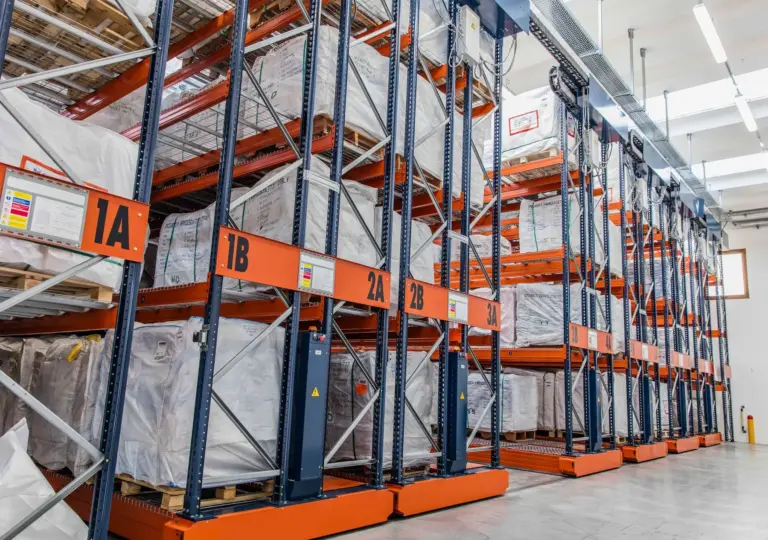
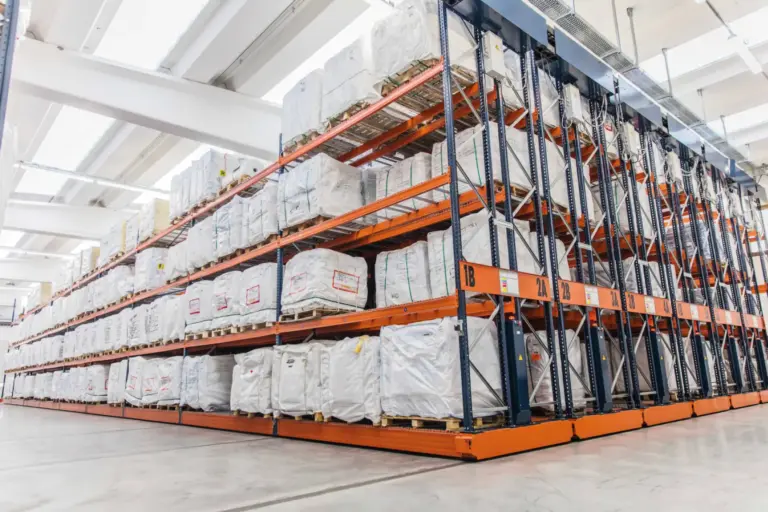
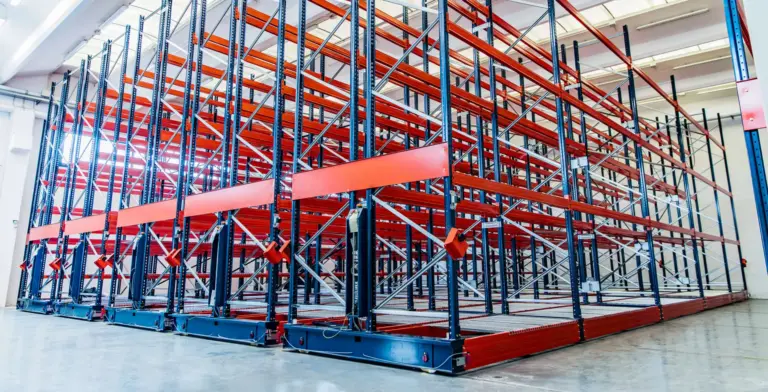
How does motorised movement of the mobile bases work?
The mobile bases are driven by electric motors, typically controlled by inverters, providing smooth acceleration and deceleration as the aisles open and close. This helps reduce mechanical stress and operating noise. Base positioning is controlled by encoders and/or safety limit switches, while movement is activated using a hold-to-run control panel or a portable remote control.
System safety is ensured by a range of dedicated safety devices, selected and configured according to the layout and frequency of use:
- Perimeter photoelectric safety barriers that bring the system to a stop when a person or obstacle is detected in the aisle.
- Safety edges fitted to the ends of the mobile bases, providing immediate system shutdown in the event of contact.
- Emergency stop buttons positioned along the front of the system.
- Visual and audible warning signals that alert operators before the mobile bases start moving.
- Anti-derailment guides and anti-tip devices installed along the floor-mounted rails.
Storage capacity of powered mobile racking
Compared with conventional pallet racking with fixed aisles, powered mobile racking can typically provide up to 80–90% more storage capacity. By eliminating most of the space normally required for permanent operating aisles, the system makes it possible to use the available floor area for additional pallet positions.
This makes powered mobile racking particularly advantageous where warehouse space is limited or expensive, such as in urban locations, existing warehouse extensions and temperature-controlled environments.
Higher storage density does not come at the expense of selectivity: each mobile base can be moved independently, providing direct access to every stored SKU, unlike high-density storage systems that require goods to be loaded and retrieved in a specific sequence. This makes the solution suitable for warehouses handling a large number of different SKUs with medium to high stock turnover.
Safety and standards for powered mobile racking
One of the key technical differences between powered mobile racking and static racking lies in the applicable regulatory framework. Because it incorporates mechanically driven movement, the complete “racking + mobile bases” system falls within the scope of the Machinery Directive 2006/42/EC and therefore requires CE marking for the installation as a whole, rather than for the electromechanical components alone. Safety circuits are designed in accordance with EN ISO 13849-1, while the structural design of the racking is based on UNI EN 15620, covering tolerances and clearances, and UNI EN 15629, covering equipment specifications. Use and maintenance are addressed by UNI EN 15635.
In seismic areas, the design takes into account the response spectra specified in UNI EN 16681, with specific checks on the rail anchorage and supporting floor. Once installed, the system must be supplied with an operation and maintenance manual and undergo periodic inspections, in line with the requirements applicable to other CE-marked storage equipment.
Sectors and applications of powered mobile racking
Thanks to their high storage density and electrically controlled access, powered mobile pallet racking can be used across a wide range of operational environments:
- Cold stores and frozen food warehouses, where the higher storage density allows more goods to be kept at the required temperature within the same available volume, helping to reduce energy consumption.
- Industrial warehouses with limited floor space, where storage capacity can be increased without requiring additional floor area.
- Distribution centres handling a wide range of SKUs, where direct and frequent access is required to a large number of different items.
- Buffer and staging areas, where aisles need to be opened and closed quickly according to the workflow and operational requirements of each shift.
Custom design of powered mobile racking
Each powered mobile racking installation is designed following a technical site survey that assesses the type and weight of the loads to be stored, available clear height, inbound and outbound material flows, and the required access frequency for each SKU. These parameters form the basis for the structural calculation report, including a seismic assessment where required by applicable regulations. The layout is then developed to achieve the right balance between storage density and operational efficiency.
For existing installations, a periodic technical inspection of the racking can also be carried out to assess its compliance and overall condition.
FAQ
With manually operated mobile bases, aisles are opened using a crank or handwheel operated directly by the user, making this configuration suitable for lighter loads and archive storage. Powered mobile bases, by contrast, are driven by an electric motor controlled via a push-button panel, remote control or WMS. They are typically used for palletised loads and applications requiring frequent access, as they reduce operator effort and allow aisles to be opened more quickly.
Yes. As a mechanically driven system, the combined racking and mobile bases assembly falls within the scope of the Machinery Directive 2006/42/EC and must be CE marked as a complete system.
Eliminating fixed aisles typically increases storage capacity by around 80–90% within the same floor area, while maintaining direct access to every pallet.
Yes. By eliminating fixed aisles, powered mobile bases make better use of the available space: more goods can be stored within the same volume of air to be cooled, significantly reducing the energy cost per pallet.