

Drive-In Racking for High-Density Pallet Storage
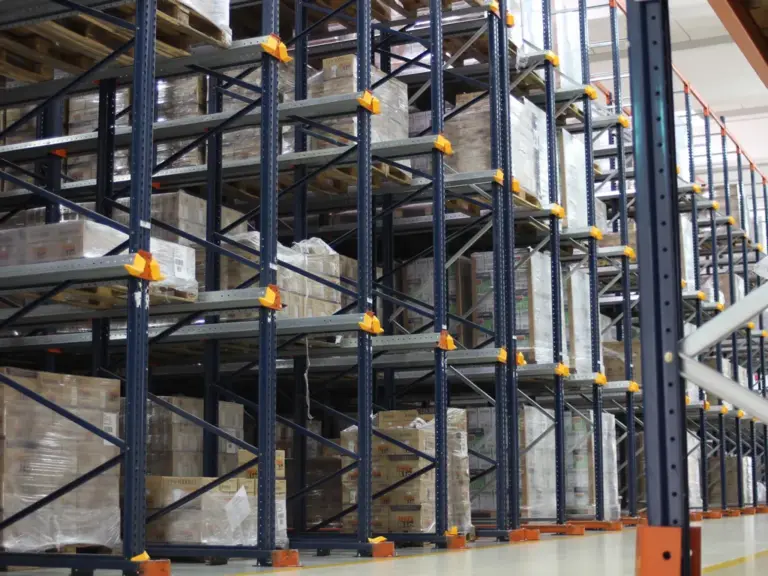
Le scaffalature metalliche Drive-In fanno parte della gamma di scaffalature portapallet per lo stoccaggio intensivo e sono progettate per garantire il massimo sfruttamento del volume disponibile in magazzino, riducendo al minimo gli spazi non produttivi. Il sistema elimina i corridoi di prelievo tra le campate, permettendo al carrello elevatore di entrare direttamente nel canale di carico e accumulare i pallet in profondità, uno dietro l’altro, su guide laterali fissate ai montanti.
This configuration follows the LIFO (Last In, First Out) principle, whereby the last pallet placed in the storage lane is the first to be retrieved. For this reason, drive-in racking is particularly well suited to storing homogeneous products with a limited number of SKUs but a high number of pallets per SKU, and where stock turnover is relatively low.
Drive-In Racking Structure
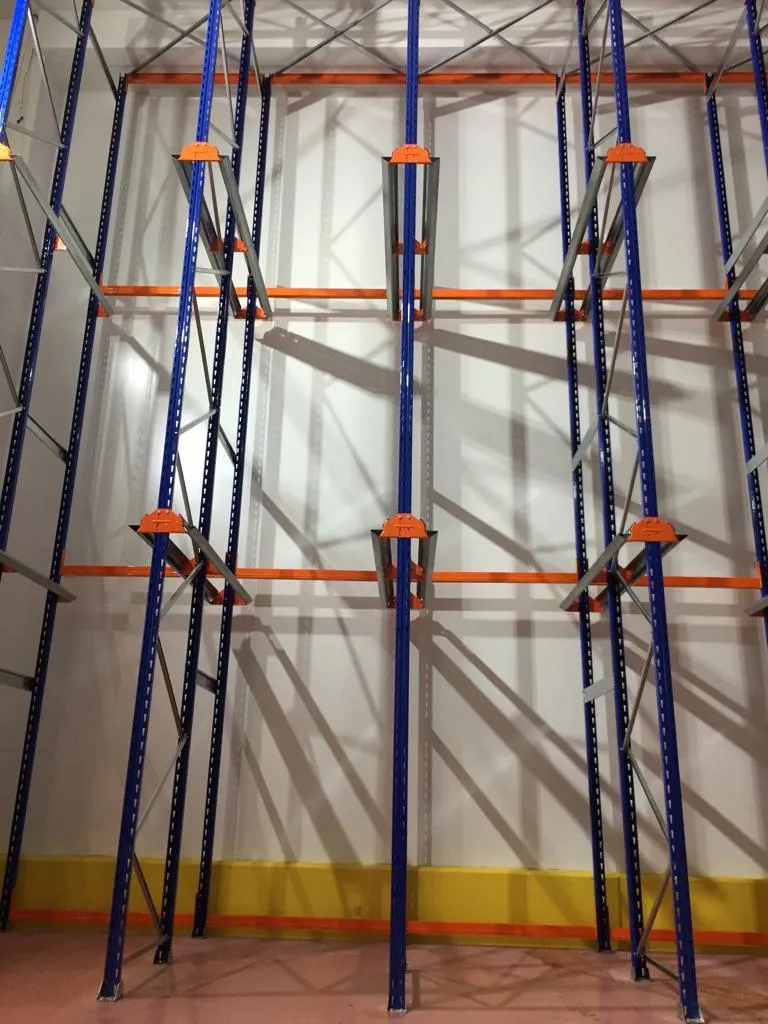
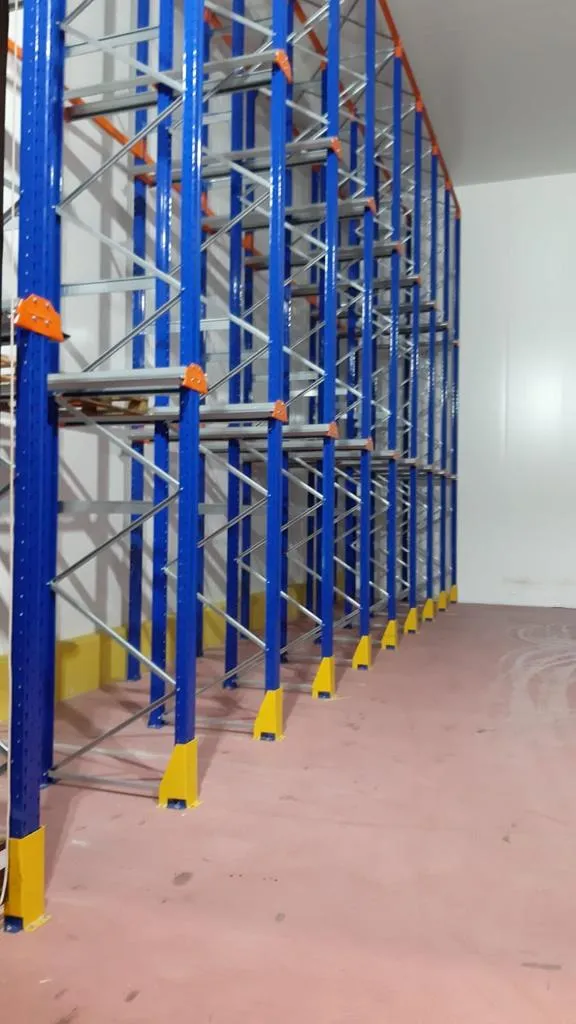
Each storage lane consists of pairs of pallet rails attached to the vertical uprights, on which the load units rest and slide as they are placed into the rack. At the entrance to each lane, protective elements and centring guides are generally installed to facilitate forklift manoeuvring and reduce the risk of impact with the structure.
In deeper storage lanes, floor-mounted guide rails may also be installed to help keep the forklift aligned during pallet placement and retrieval. The structure is further reinforced with bracing, which is designed and dimensioned during the engineering stage to ensure the stability of the racking system, including when fully loaded.
The ideal solution for increasing storage density
Thanks to its optimised structural design, the drive-in system makes efficient use of every available centimetre of height, width and depth, significantly improving space utilisation and increasing the warehouse’s overall storage capacity.
This type of racking is also suitable for storing goods that require specific environmental conditions, such as cold stores or temperature-controlled facilities. By reducing the number of access aisles, it allows significantly more goods to be stored within the same available volume, helping to improve energy efficiency.
Drive-in racking can be configured to meet the specific requirements of each warehouse, based on pallet dimensions, load units and operating conditions. It provides a flexible and effective solution for maximising storage density while maintaining structural safety.
Benefits of Drive-In Racking
Optimising warehouse space is key to improving operational efficiency and reducing operating costs. Drive-in racking allows businesses to increase storage capacity within the same floor area, reducing the need to expand or build additional warehouse space. More efficient use of available storage volume can simplify handling operations, reduce operating times and improve overall warehouse productivity.
- Up to 85% more efficient use of warehouse floor space compared with conventional pallet racking
- Simplified SKU management, with one SKU assigned to each storage lane, helping to reduce picking errors
- A robust and reliable structure designed to handle heavy loads
- Reduced volume requiring temperature control in cold stores and refrigerated facilities
When to Choose Drive-In Racking
Drive-In racking is particularly well suited to warehouses handling large volumes of the same or similar products, such as food and beverages, building materials, and goods that require ageing or long-term storage. It is also an effective solution where space is expensive or temperature-controlled environments, such as cold stores, make storage density a higher priority than direct access to individual pallet locations.
Design, structural calculations and safety
Like any industrial racking system, Drive-In racking must be designed in accordance with the applicable technical standards. The key standards include UNI 11575, which specifically addresses the design of Drive-In and Drive-Through racking, along with UNI EN 15620, UNI EN 15629 and UNI EN 15635 for static steel storage systems.
Following these standards, together with sound structural calculations and the appropriate racking compliance certification, helps ensure the safety of the racking system and the people working in the warehouse.
FAQ
With Drive-In racking, the forklift accesses each storage lane from a single side, so pallets are both loaded and retrieved from the same end. This follows a LIFO (last in, first out) principle. Drive-Through racking, on the other hand, provides access from both ends of the lane, allowing pallets to be loaded from one side and retrieved from the other according to a FIFO (first in, first out) principle. This configuration is better suited to products with a limited shelf life or high stock turnover.
The depth of each storage lane is designed around the specific requirements of the warehouse. Depending on the application, a lane may accommodate just a few pallets or more than 10 pallets in depth. The appropriate configuration depends on factors such as pallet type, the forklifts used for handling and the turnover rate of the stored goods. These parameters are assessed during the design process and incorporated into the structural calculations.
Yes. Drive-In racking is particularly well suited to cold stores and other temperature-controlled environments. Because it eliminates access aisles, it reduces the overall volume that needs to be cooled or heated, helping to lower energy consumption and operating costs.
Yes. Like any industrial racking system, Drive-In racking must be properly designed and installed in accordance with the applicable technical standards, including UNI 11575, UNI 11636, UNI EN 15512, UNI EN 15620, UNI EN 15629 and UNI EN 15635. Structural calculations, racking compliance certification and load capacity signs are essential to ensure that the system is safe to use and that its permitted loads are clearly identified.