

What is Cantilever Racking?
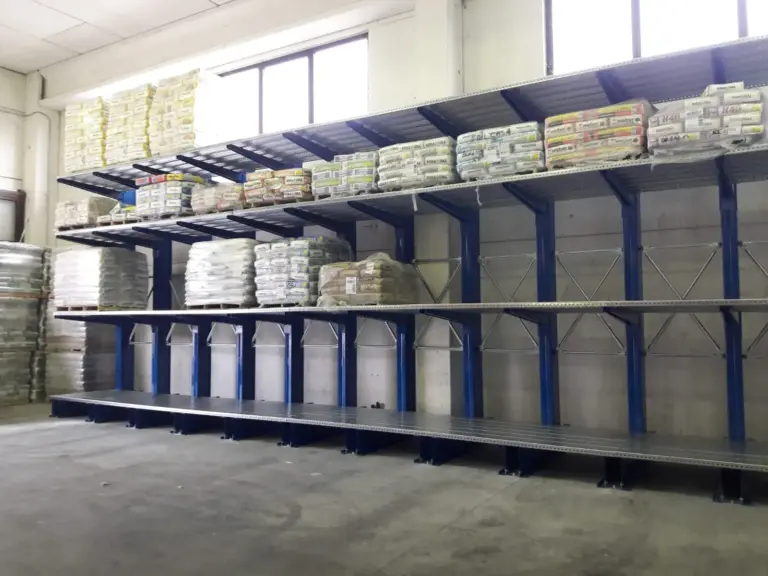
Cantilever racking is a storage system consisting of vertical columns with no front uprights, fitted with cantilever arms that support the stored materials. Unlike pallet racking, it is designed for long, bulky or rigid materials that cannot be easily accommodated in conventional storage bays. Typical applications include pipes, metal bars and sections, panels, sheet metal and timber.
Cantilever racking is the ideal solution for warehouses handling loads of varying lengths that cannot be accommodated within standard rack bay dimensions. With no front uprights, cantilever racking offers greater freedom in terms of load dimensions: materials can extend beyond the columns, be stored in bundles or placed directly on the arms, provided the loads remain within the capacity limits specified in the design.
Structure and components of cantilever racking
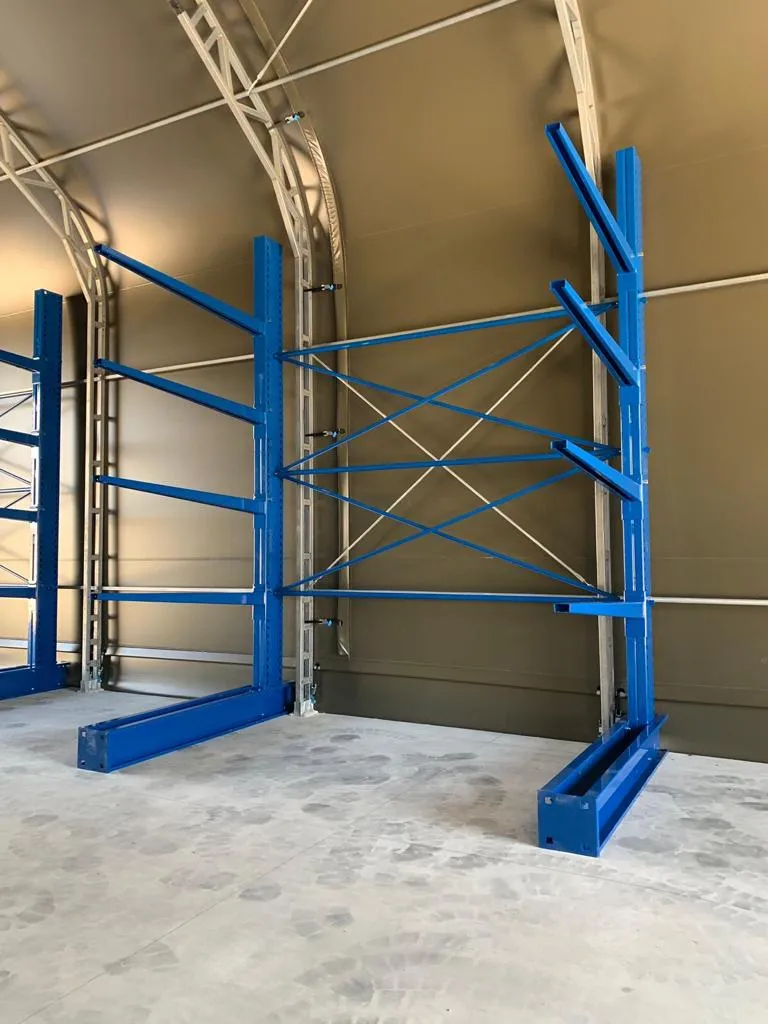
Cantilever racking consists of bases that transfer the structure’s vertical loads to the floor and vertical columns bolted to the bases through welded plates. The cantilever arms are attached to the columns and support the stored loads. Each arm is connected to the column by a connector secured with a locking pin. This connection transfers the forces generated by the stored load to the column and must therefore be regularly checked for integrity and correct positioning.
The columns are interconnected by cross-bracing, which provides overall structural stability, even in tall configurations. For outdoor installations, the system can be equipped with a roof structure with supporting profiles, gutters and downpipes, as well as side or rear cladding to protect the stored materials from the elements.
Cantilever racking configurations
Cantilever racking is available in two main configurations. Single-sided systems have arms on one side of the columns and are suitable for installation against a wall or along the warehouse perimeter. Double-sided systems have arms on both sides, allowing access from two opposite aisles. This configuration makes more efficient use of available floor space and is particularly suitable for freestanding storage rows in the centre of the warehouse.
Each cantilever racking system is designed to suit the loads it needs to handle. Key design parameters include column height, the number of storage levels, the vertical spacing between arms and arm length, which determines the available storage depth. The required load capacity of each arm and column is also defined during the design phase. This flexibility allows the system to be configured for a wide range of warehouse layouts, both indoors and in suitably prepared outdoor areas.
Industries and materials requiring cantilever racking
Cantilever racking is essential in a range of manufacturing and distribution environments:
- Mechanical engineering: bars, rods and metal sections awaiting processing.
- Construction: pipes, insulation panels and building materials of varying lengths.
- Woodworking: beams, boards and unfinished panels.
- Semi-finished product distribution: organising large quantities of different product types by length and diameter.
Operational benefits of cantilever racking
The absence of front uprights is the defining feature of cantilever racking and provides several key operational benefits:
- Direct access to stored materials: materials can be retrieved directly by forklift without having to remove or reposition other loads.
- Immediate visual access: stock at each level is visible at a glance, with no front uprights obstructing the view.
- Modularity and expandability: the system can be extended by adding further columns as storage needs increase, without requiring a complete redesign of the warehouse layout.
- Targeted maintenance: individual arms or columns can be replaced or adapted when the type of load being handled changes, without dismantling the entire system.
Technical standards and safety requirements for cantilever racking
The design of cantilever racking refers to the sector-specific standard UNI 11598:2015, which covers this type of storage system, as well as UNI EN 15629, concerning the specification of racking systems, and UNI EN 15635, which covers their use and maintenance.
From an operational standpoint, each system must display clearly visible load capacity signs, and the condition of the arms and the correct positioning of the locking pins within the columns must be checked regularly. Where there is a risk of loads falling, the system can be fitted with appropriate accessories, such as load retention stops or column guards in areas exposed to forklift traffic.
Custom-designed cantilever racking
Each cantilever racking system is designed around the specific characteristics of the materials to be stored, including their type, length, weight per item and how they are supported, as well as the available warehouse space and the lifting equipment used. Di Massa manages the entire analysis and design process, from surveying the storage areas to defining the most suitable column heights, arm spacing and load capacities to support the customer’s workflow.
FAQ
In a single-sided configuration, the arms are mounted on one side of the columns, making it suitable for installation against a wall or along the warehouse perimeter. In a double-sided configuration, the arms are mounted on both sides, providing access from two opposite aisles. This makes it ideal for freestanding storage rows in the centre of the warehouse, allowing more efficient use of the available floor space.
Cantilever racking is suitable for storing long or irregularly shaped materials that are not easily accommodated on conventional pallet racking. Common examples include pipes, bars, metal sections, panels, sheet metal, timber and industrial semi-finished products, provided that their weight and length remain within the design parameters.
Yes, provided the system is designed specifically for outdoor installation. In this case, the structure can be equipped with a roof and, where required, side or rear walls to protect the stored materials from the elements and preserve the integrity of the metal components over time.
The design of cantilever racking is based on the sector-specific standard UNI 11598:2015, which covers cantilever storage systems, together with UNI EN 15629 and UNI EN 15635, which address the application and maintenance of storage systems.