


What are steel rack upright protectors?
Steel rack upright protectors are designed to protect the base of pallet racking uprights from accidental impacts caused by material handling equipment. In warehouses where forklifts and pallet trucks operate, aisle entrances, manoeuvring areas and high-traffic zones are particularly vulnerable to collisions with the racking structure.
Racking uprights are key load-bearing components that support the loads carried by each bay. Impacts can cause deformation, compromising the integrity of the uprights and potentially reducing the load-bearing capacity of the racking, depending on the severity and location of the damage. Protecting the lower sections of the uprights is therefore an important aspect of industrial racking safety management.
Upright protectors provide a physical barrier between material handling equipment and the racking structure, helping to reduce the impact of collisions at the base of the uprights. The most suitable solution should be selected according to the racking layout, available manoeuvring space and the level and type of traffic within the warehouse.
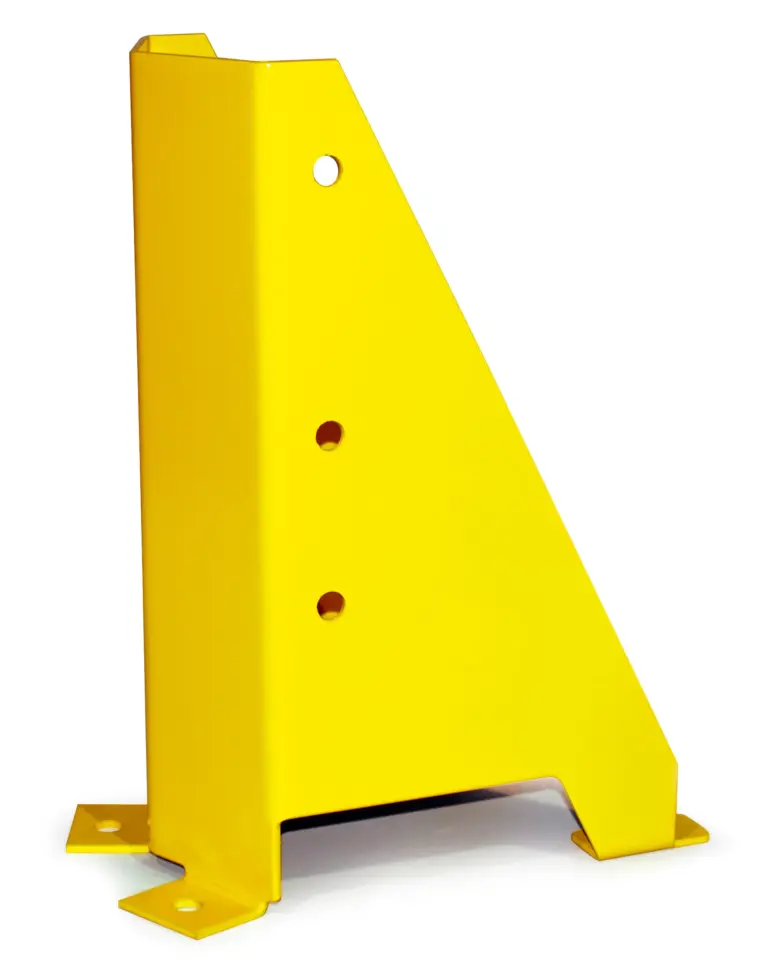
How steel rack upright protectors work
Steel rack upright protectors are designed to suit different racking configurations and installation methods. Positioned around the base of each upright, they provide a protective barrier that intercepts impacts from material handling equipment, helping to prevent direct contact with the racking structure wherever possible.
Depending on its material and design, the protector may absorb some of the impact energy by deforming or transfer the resulting forces to the fixings and the floor. Its effectiveness therefore also depends on correct installation and on the anchoring system being suitable for the anticipated impact forces.
Steel protectors are generally made from folded sheet metal and are designed to provide high mechanical strength. They can be secured to the floor using anchor bolts or other anchoring systems, with multiple fixing points where required, depending on the protector design and the characteristics of the installation area. This configuration helps keep the protector in its intended position when an impact occurs.
Technical specifications of steel rack upright protectors
Steel rack upright protectors are available in a range of sizes to suit different upright profiles and the space available around the racking. The height, width and thickness of the protector vary depending on the model and the characteristics of the installation area. Before selecting a suitable protector, the upright dimensions and available clearance must be checked to ensure correct positioning.
For improved visibility, steel rack upright protectors are commonly finished in yellow, sometimes with black elements, making them easy for warehouse operators and forklift drivers to identify. High-visibility colouring helps operators spot the protectors during manoeuvres and makes their presence more noticeable in traffic areas.
Applications of steel rack upright protectors
Steel rack upright protectors are used in warehouse areas where racking uprights are most exposed to potential impacts from material handling equipment. They are particularly suitable for locations where manoeuvres take place close to the racking structure, such as:
- Traffic aisles and intersections, where forklifts frequently pass and manoeuvre.
- Racking end frames, where uprights may be exposed to impacts as forklifts enter and exit aisles.
- Loading and unloading areas where pallet handling takes place close to the racking.
Benefits of steel rack upright protectors
Installing impact protectors at the base of racking uprights can help reduce the consequences of accidental impacts and limit the costs associated with damage management. The main operational benefits include:
- Reduced repair costs by protecting racking uprights from impacts caused by material handling equipment, helping to reduce the frequency of damage.
- Improved operational continuity by reducing the likelihood of damage that could require inspections or repairs, or lead to the temporary removal of affected racking from service.
- Improved visibility of protective devices, particularly when high-visibility finishes are used, making them easier to identify during manoeuvres.
- The ability to protect existing racking without modifying its load-bearing structure.
Safety of pedestrian and vehicle routes in warehouses
Italian Legislative Decree No. 81/2008 (the Consolidated Act on Occupational Health and Safety) sets out employers’ general obligations to assess risks and implement the preventive and protective measures necessary to safeguard workers. These include risks arising from traffic within the workplace and potential interactions between pedestrians and material handling equipment.
Depending on the risks identified through the company’s risk assessment, appropriate measures may include route planning, clearly defined traffic areas, signage and physical barriers. These measures form part of the overall prevention system and must be considered in the company’s Risk Assessment Document.
Custom-designed steel rack upright protectors
To identify the most suitable solution, we assess the racking configuration and the material handling equipment in use, taking into account the upright profile and the operating conditions in the area. Based on these factors, we select the steel rack upright protector best suited to the structure’s requirements and the level of protection needed.
The aim is to provide a solution that protects the areas most exposed to impacts while remaining compatible with the existing racking configuration and normal material handling operations.
FAQ
Steel and polymer rack protectors differ in their design and approach to impact protection. Steel models are generally anchored to the floor and provide a rigid barrier, while polymer protectors are designed, depending on their configuration, to absorb and distribute impact energy through material deformation. Some polymer models can also be attached directly to the upright without the need for floor anchoring. The most suitable option depends on the racking configuration, the type of material handling equipment in use, handling operations and the operating conditions in the area.
Yes, steel rack upright protectors can be installed on existing pallet racking, provided the selected solution is compatible with the racking configuration and available space. Before installation, the upright dimensions, protector positioning and, where applicable, the floor conditions and anchoring system must be checked.
A rack upright protector should be inspected after a significant impact to ensure that it remains correctly positioned, securely fixed and in suitable condition to perform its protective function. If it shows signs of deformation, damage or issues with the fixing system, it may need to be repaired or replaced. The assessment should also take into account the severity of the impact and the condition of the protector.