


What are polymer warehouse safety barriers?
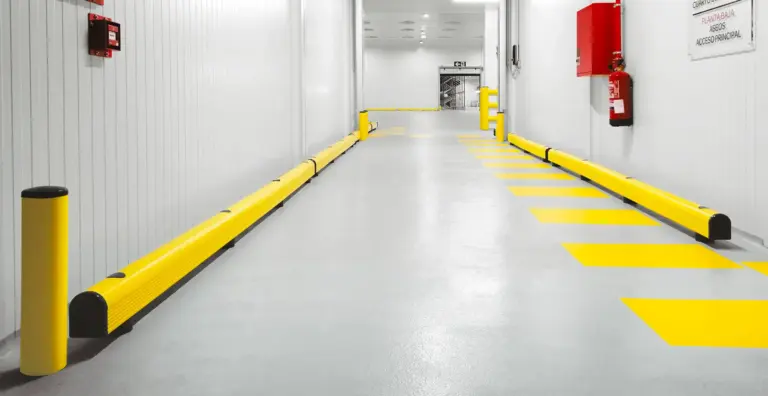
Polymer warehouse safety barriers are designed to absorb accidental impacts from forklifts and pallet trucks, protecting walls, racking and warehouse equipment. Unlike conventional steel barriers, those made from engineered polymers combine impact energy absorption with corrosion resistance, while reducing maintenance associated with rust and repainting. These properties make them particularly suitable for humid environments, areas exposed to cleaning agents and facilities subject to frequent washing, such as food and pharmaceutical warehouses.
As a modular system, polymer safety barriers can be installed, extended or reconfigured without structural building work or lengthy operational downtime, allowing them to accommodate changes to the warehouse layout over time. Their flexibility and reduced maintenance requirements make them a durable, long-term solution that helps reduce indirect costs associated with production downtime and repairs.
Where to install polymer warehouse safety barriers
Polymer safety barriers are installed in areas where material handling equipment operates close to walls, racking, machinery or pedestrian routes and work areas. Typical applications include defining vehicle traffic lanes, protecting rack ends exposed to forklift traffic, safeguarding loading and unloading areas against impacts from material handling equipment, and physically separating vehicle routes from pedestrian areas.
Technical Specifications of Polymer Warehouse Safety Barriers
Polymer safety barriers share several key design features, although specific details vary depending on the model and configuration selected:
- Mechanical floor fixing: Mechanical anchors secure the barrier to the floor, ensuring stability and allowing it to perform as intended in the event of an impact.
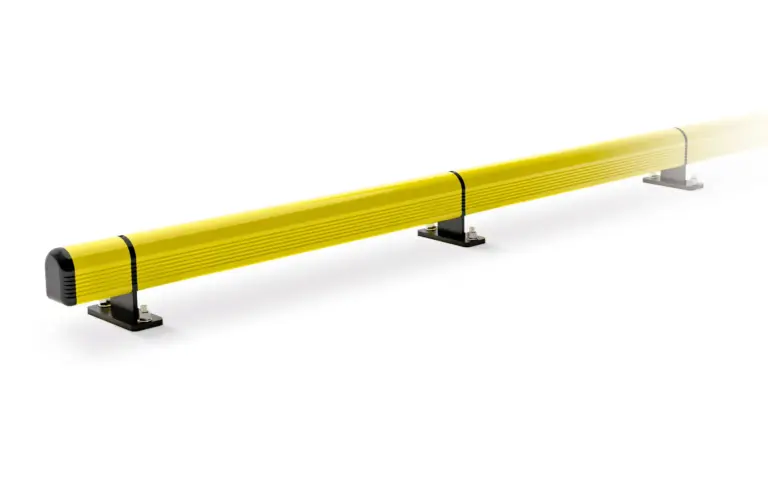
- Modular design: Barrier sections can be connected to create protective systems of varying lengths, tailored to the specific layout of the warehouse.
- Single-rail or double-rail configurations: The appropriate design is selected according to the characteristics of the area to be protected, the material handling equipment in use and the level of protection required.
- Different impact resistance ratings: Available models vary in their ability to absorb impact energy, which must be assessed in relation to the characteristics of the vehicles in use and the operating conditions of the area.
Advantages of polymer warehouse safety barriers
Compared with conventional steel barriers, polymer safety barriers offer several practical and operational advantages:
- Corrosion resistance: Polymer does not rust or require periodic repainting, making it particularly suitable for humid environments and areas exposed to cleaning agents.
- Controlled impact energy absorption: The material deforms on impact, absorbing part of the energy generated and providing a less rigid response than a conventional steel barrier.
- Lightweight and easy to handle: Polymer components are generally easier to handle than their steel counterparts, simplifying installation, replacement and reconfiguration.
- High visibility: High-contrast colours, commonly used in industrial safety systems, make barriers easier to see and help operators spot them during material handling operations.
Standards applicable to warehouse impact protection systems
Italian Legislative Decree 81/2008 requires employers to provide a safe working environment by assessing risks associated with the movement of mechanical handling equipment and implementing appropriate measures to protect workers, structures and equipment from accidental impacts. Installing impact protection barriers along high-risk routes is one of the technical measures commonly adopted for this purpose.
For racking systems, standard UNI EN 15635 covers the safe use and maintenance of storage equipment and also addresses the use of passive protection at points exposed to impact risks. Protective devices must be kept in a suitable condition to perform their intended function. If a protective component is damaged, its condition must be assessed and it must be repaired or replaced in accordance with the requirements applicable to the system.
Custom design of polymer safety barriers
We help businesses assess material handling flows, identify high-risk traffic areas and evaluate warehouse layouts to determine the most suitable polymer safety barrier configuration for protecting walls, racking, machinery and other structures exposed to impact. Based on this assessment, we establish which areas require protection, select the appropriate fixing methods and define the barrier configuration best suited to the vehicles in use and the operating conditions, ensuring effective, long-term protection.
FAQ
Unlike conventional steel barriers, polymer safety barriers are corrosion-resistant and do not require periodic repainting. Their ability to deform on impact also allows them to absorb part of the impact energy. The choice between the two solutions depends on the environmental conditions, the material handling equipment in use and the level of protection required.
Polymer safety barriers are suitable for both indoor and outdoor use. Models specifically designed for demanding environments can also be used in areas exposed to high humidity, frequent washdowns or low temperatures. Typical applications include material handling routes, loading and unloading areas, and locations where walls, racking, machinery or other structures are at risk of impact.
Polymer safety barriers are secured to the floor using mechanical anchors, with the fixing method determined by the specific model. The material does not require anti-corrosion treatments or repainting. However, the barriers must be inspected periodically, and any components damaged to the point of compromising their protective function must be replaced.