


What are polymer rack upright protectors?
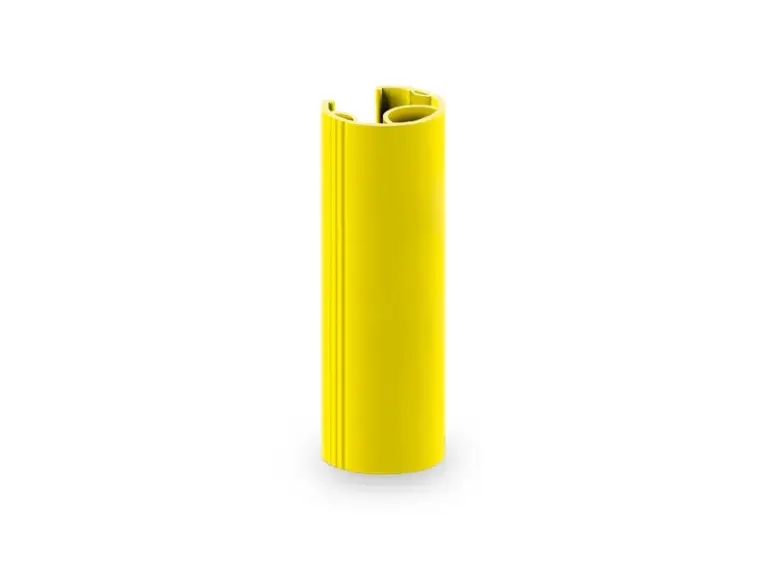
Polymer rack upright protectors are safety devices fitted at the base of racking in areas where forklift trucks and pallet trucks operate in close proximity to the structure. Accidental contact with uprights is one of the most common incidents during routine materials handling. Even a seemingly minor impact can deform the metal profile, and if the damage goes undetected and is not repaired, it can gradually reduce the structure’s load-bearing capacity. Polymer rack upright protectors help prevent impacts from reaching the structural members by absorbing the energy generated and limiting the forces transferred to the racking.
Polymer upright protectors are a cost-effective way to protect valuable racking components. Damage to an upright often requires its replacement, temporarily taking the affected bay out of service and, in more serious cases, carrying out an additional structural assessment. Installing suitable protectors in areas most exposed to impact helps reduce the need for such interventions and maintain the racking system’s required safety conditions over time.
How do polymer rack upright protectors work?
Polymer rack upright protectors are installed directly to the uprights at the height most exposed to impacts from handling equipment. When struck, the high-strength polymer deforms in a controlled way, absorbing and dissipating impact energy while reducing the forces transferred to the underlying metal profile. Unlike rigid steel protectors, the flexibility of polymer helps cushion impacts, reducing their effects on both the racking structure and the handling equipment.
Installation requires no floor fixings or drilling. The protector fits directly onto the existing structure, with no building work or prolonged downtime required.
Technical specifications of polymer rack upright protectorsCaratteristiche tecniche delle protezioni per montanti in polimero
Although their size and configuration vary depending on the model and the upright to be protected, polymer rack upright protectors share several core design features that make them a reliable solution for most racking systems.
- Made from high-impact-resistant polymer
- Designed to absorb impact energy and reduce the forces transmitted to the upright
- Available in various sizes and configurations to suit the upright profile being protected
- Suitable for racking systems from different manufacturers, subject to compatibility checks
Benefits of polymer rack upright protectors
Polymer rack upright protectors help prevent serious damage caused by material-handling equipment striking the racking, reducing replacement and maintenance costs over time:
- No floor fixings required
- Installed directly onto the upright, with no screws or anchors required
- The absence of floor anchoring eliminates the risk of the protector being torn away in the event of more severe impacts.
- The rounded profile allows handling equipment to manoeuvre more easily alongside the racking while minimising the space occupied in traffic aisles.
- Absorb impact energy, reducing the forces transmitted to the upright.
Where to install polymer rack upright protectors
Rack upright protectors are particularly suitable for areas with the highest levels of forklift and pallet truck traffic, such as main travel aisles, loading and unloading zones, manoeuvring and turning areas, pallet racking row ends and high-throughput picking areas. In distribution warehouses and logistics centres, where material-handling activity is particularly intensive, installing protectors at all points most exposed to impact can significantly reduce the frequency of racking damage identified during periodic inspections.
Racking safety standards
UNI EN 15635, which covers the use and maintenance of steel storage racking, identifies upright protection as a preventive measure against impact damage. The condition of these protectors should be checked during the periodic inspections outlined in the standard. Across the industry, the impact resistance of such devices is generally assessed through standardised impact tests that measure the energy absorbed and the extent to which the forces transmitted to the racking structure are reduced. Italian Legislative Decree No. 81/2008 also requires employers to implement the technical and organisational measures necessary to minimise risks associated with the use of work equipment.
Custom design of polymer rack upright protectors
Warehouse layouts vary in their exposure to impact risks. The most suitable protection depends on the upright profile width, the intensity of forklift and pallet truck traffic within the aisles, and the position of the racking in relation to material-handling routes. By assessing the warehouse layout and the characteristics of the existing racking, we select the most appropriate protectors in terms of size and positioning, prioritising areas most exposed to impacts, such as racking row ends and vehicle manoeuvring areas.
FAQ
It depends on the model. Some protectors fit directly onto the racking upright, without screws or floor fixings. This avoids drilling into or damaging the warehouse floor and allows for quick installation, even in warehouses that remain operational.
Where the risk of impact is higher, floor-anchored polymer protectors can be supplied on request. These are positioned slightly away from the upright to minimise the transmission of impact-induced vibrations to the racking structure.
Polymer protectors are more flexible and absorb impact energy through controlled deformation, reducing the forces transmitted to both the racking upright and the handling equipment. Steel protectors are generally more rigid and floor-anchored, making them suitable for areas exposed to higher-impact forces.
There is no universal legal requirement to install upright protectors on every racking system. Employers must assess the risk of accidental impact in their workplace and implement appropriate technical and organisational measures. Where the risk assessment identifies a need, these measures may include upright protection, in accordance with Italian Legislative Decree No. 81/2008 and the recommendations of UNI EN 15635 on the use and maintenance of racking systems.