


The importance of polymer rack-end impact protectors
Rack ends are particularly exposed to accidental impacts from material handling equipment. During pallet handling operations, manoeuvring near the ends of rack runs and steering errors can cause forklift trucks and pallet trucks to collide with the rack uprights. In areas with a higher risk of impact, dedicated protective systems should be installed to prevent handling equipment from coming into direct contact with the racking.
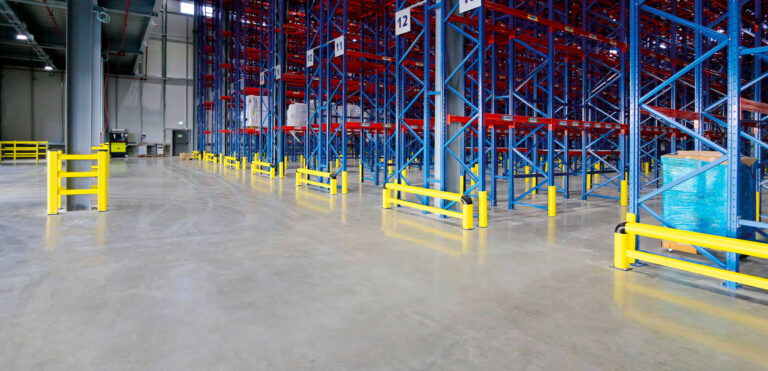
Polymer rack-end impact protectors are positioned in front of the rack uprights to form a physical barrier between the racking and material handling equipment. The polymer material is designed to absorb impact energy, reducing the force transmitted to the racking structure. This helps protect uprights in areas particularly prone to impacts and minimises the risk of damage arising from routine warehouse operations.
Where to install polymer rack-end impact protectors
The areas requiring protection should be identified by assessing material handling flows and the space available for manoeuvring. The warehouse’s industry sector is less relevant than the aisle layout and the frequency with which handling equipment operates near the ends of rack runs.
Rack-end protectors are particularly useful at the ends of rack runs facing traffic aisles, at aisle intersections and wherever forklift trucks and pallet trucks frequently manoeuvre close to the racking. Areas with limited manoeuvring space also require particular attention, as reduced clearance between handling equipment and the racking increases the risk of accidental impact.
Technical features of polymer rack-end impact protectors
Polymer rack-end impact protectors are secured directly to the floor using mechanical anchors, without the need to modify or drill the rack uprights. The configuration is determined by the characteristics of the racking and the operating conditions in the area, allowing the dimensions and level of coverage to be tailored to the specific area requiring protection.
- Material: High-strength polymer
- Fixing: Floor-mounted using mechanical anchors
- Compatibility: Suitable for single-sided and double-sided racking, with configurations adaptable to different upright frame designs.
- Sizing: Determined by the racking configuration, available space and level of exposure to impact.
Benefits of polymer rack-end impact protectors
Installing polymer rack-end protectors helps reduce the risk of damage to the racking. A dedicated protective barrier helps to:
- Protect the uprights from direct contact with material handling equipment, reducing the effects of frontal impacts.
- Improve safety in traffic areas, particularly along forklift truck aisles and at aisle intersections.
- Reduce costs associated with racking damage by minimising the need to replace structural components and the resulting operational downtime wherever possible.
- Add protection to existing racking without modifying the configuration of the installed structure.
Racking safety standards
Impact protection systems help mitigate the risks associated with handling loads near racking. Under UNI EN 15635, these protective devices must also be checked during racking inspections to assess their condition and identify any damage. The proper management of racking and its protective systems also forms part of the wider safety obligations established by Italian Legislative Decree 81/2008, which requires equipment and workplaces to be maintained in a condition that safeguards workers.
Custom design of polymer rack-end impact protectors
No single rack-end protector is suitable for every warehouse layout. Selecting the most effective solution requires an assessment of the racking type and layout, the available manoeuvring space and the movement patterns of material handling equipment.
We also determine the positioning of the protectors based on aisle geometry and access points, ensuring that the areas most exposed to impacts are protected without disrupting routine material handling operations. By assessing the existing layout, we establish the appropriate dimensions, number and placement of the protectors to meet the warehouse’s specific configuration and operational requirements.
FAQ
There is no specific legal requirement to install a particular type of protective system. However, the choice of protective measures must take into account the risks present in the workplace, including the possibility of collisions between material handling equipment and racking.
Yes. The system can be installed on existing racking without modifying the structure itself. Compatibility is assessed based on the upright frame configuration and available space, for both single-sided and double-sided racking.
The protector is positioned in front of the rack end and anchored directly to the floor using mechanical fixings. It is installed at a suitable distance from the racking to form a barrier between the uprights and material handling equipment. Installation can also be carried out in an operational warehouse without altering the existing racking structure.