


What are polymer pedestrian barriers?
Polymer pedestrian barriers are physical separation systems used to separate pedestrian walkways from routes used by forklifts, pallet trucks and other material handling equipment. They establish a clearly visible, physical boundary between the two areas, helping reduce the risk of pedestrians inadvertently entering vehicle operating zones or material handling equipment encroaching on pedestrian walkways during manoeuvres.
The system consists of vertical posts and horizontal rails assembled into modules and installed along the route to be protected. The polymer rails are designed to absorb part of the energy generated by an accidental impact and recover their original shape. Unlike rigid structures, which may undergo permanent deformation following an impact, polymer barriers can often reduce the need for repairs after minor collisions.
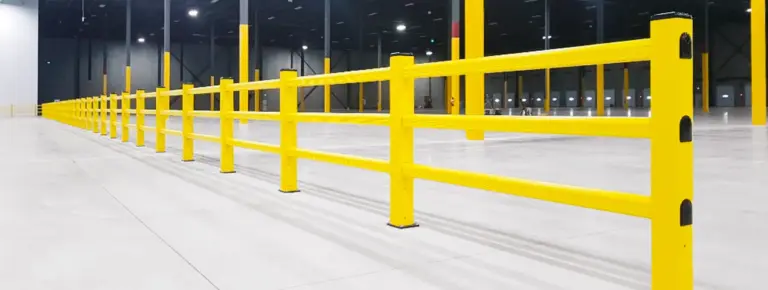
Polymer pedestrian barriers to reduce the risk of interaction between pedestrians and material handling equipment
In warehouses and distribution centres where pedestrians and material handling equipment operate in shared spaces, interactions between the two are a major source of workplace accidents. Higher-risk situations typically arise at aisle intersections, around corners with restricted visibility, and in manoeuvring areas, where vehicle operators must manage loads and manoeuvres while accounting for the presence of pedestrians.
Floor markings and warning signs alone cannot eliminate the risk, as they do not physically prevent access to hazardous areas. Their effectiveness depends on pedestrians and vehicle operators remaining alert, which can be compromised by poor visibility, high noise levels or sustained workloads. Pedestrian barriers establish a physical boundary that clearly defines the designated route, helping prevent collisions by reducing reliance on individual awareness and behaviour.
Technical specifications of polymer pedestrian barriers
Regardless of the specific model, polymer pedestrian barriers share several common design features:
- Vertical posts and horizontal rails assembled into modular sections that can be connected to form a continuous barrier along the designated route.
- Posts secured to the floor to ensure the barrier remains stable along its entire length.
- Horizontal rails positioned at different heights to provide a clear visual and physical boundary at both body level and near floor level.
- Components made from impact-resistant polymer, available in versions designed for light impacts from manual handling activities or for impacts involving forklift traffic.
Benefits of polymer pedestrian barriers
Installing polymer pedestrian barriers offers several benefits in terms of safety, workplace organisation and the protection of operational areas:
- Clearly separate pedestrian walkways from vehicle routes, reducing the risk of accidental interaction between the two.
- Their modular design allows them to be adapted to the warehouse layout, with straight, corner or more complex configurations to suit the route.
- The modules can be dismantled and repositioned to accommodate changes in production or logistics requirements, allowing pedestrian routes to be reconfigured without replacing the entire system.
- The elastic properties of the polymer allow the barriers to absorb minor accidental impacts without necessarily compromising their functionality.
- The components’ high-visibility colours make protected pedestrian routes easy to identify for both pedestrians and vehicle operators.
Safety of pedestrian and vehicle routes in warehouses
Legislative Decree No. 81/2008, Italy’s consolidated act on occupational health and safety, establishes employers’ general obligations to assess risks and implement the preventive and protective measures necessary to safeguard workers. These include risks associated with traffic within the workplace and potential conflicts between pedestrians and material handling equipment.
Within this framework, the organisation of routes, the segregation of traffic areas, signage and any physical barriers are measures that may be adopted according to the risks identified through the company’s risk assessment. These measures must be considered as part of the overall prevention system and reflected in the relevant Risk Assessment Document
Custom design of polymer pedestrian barriers
We work with each customer to define a protection system tailored to the warehouse layout. This involves reviewing the floor plan, analysing pedestrian and material handling equipment traffic flows, and identifying areas where interactions are most likely to occur. Based on this assessment, we determine the positioning of the barriers and the routes requiring protection, establishing where continuous barriers are needed and where protection can be concentrated on areas most exposed to impact.
FAQ
A pedestrian barrier is designed to define and separate a route, creating a continuous boundary between pedestrian areas and vehicle traffic lanes. An impact protection barrier, by contrast, is intended to protect a specific point exposed to impact, such as a racking end frame or upright, rather than to define or separate a route.
Yes. Polymer pedestrian barriers are available in configurations designed to separate pedestrian routes from areas used by forklifts and other material handling equipment. The appropriate solution should be selected according to the level of risk, traffic flows and the impact resistance required.
Pedestrian barriers generally consist of modular components connected to one another and anchored to the floor. This configuration allows the barriers to follow the route, accommodating changes in direction and more complex layouts. The fixing system and arrangement of the components are determined by the model used and the characteristics of the installation area.