


What are polymer impact protection bollards used for?
Polymer impact protection bollards are designed to absorb energy from accidental impacts involving forklifts, pallet trucks and other material handling vehicles in warehouses, manufacturing facilities and logistics areas. They are installed in locations particularly exposed to collision risks, such as in front of industrial doors and overhead doors, at the corners of buildings and equipment, near loading bays, and where pedestrian walkways intersect with vehicle routes.
These bollards serve a dual purpose: they provide a visible warning of potential collision hazards and act as a physical barrier to stop or slow moving vehicles, helping to reduce the risk of damage to buildings, equipment and infrastructure, as well as injury to personnel.
Unlike steel alternatives, high-performance polymer bollards offer different impact-absorption properties. Their greater flexibility allows them to deform under impact and absorb part of the energy released, helping to limit the forces transmitted to the floor anchors and reduce the risk of damage to both the bollard and the vehicle involved in the collision.
The material is corrosion-resistant and retains its mechanical properties in damp environments, when exposed to chemicals and at low temperatures. Polymer impact protection bollards are therefore suitable for indoor and outdoor installations, including cold storage facilities, where conventional metal protection systems may be more susceptible to wear.
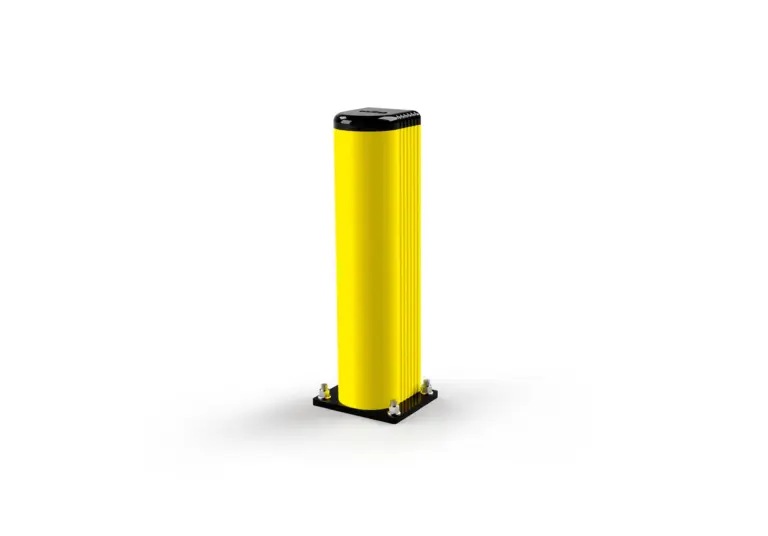
Applications for polymer impact protection bollards
Polymer impact protection bollards are used in virtually any environment where material handling vehicles and pedestrians share the same space. In logistics facilities and warehouses, they protect racking, structural columns and loading doors. In retail distribution centres and the food industry, they are also used in cold storage rooms and temperature-controlled storage areas, thanks to the polymer’s resistance to low temperatures. In manufacturing and automotive facilities, they are commonly installed to protect machinery, production lines and workstations exposed to forklift traffic.
Across all these environments, installation points should be selected following an assessment of vehicle and pedestrian traffic flows to identify the areas most exposed to impact risks.
Technical specifications of polymer impact protection bollards
The main design and construction features of these protection devices include:
- Floor anchoring to ensure stability and transfer impact forces to the anchoring base
- Suitable for indoor and outdoor environments, including cold storage facilities
- Corrosion and low-temperature-resistant polymer material
- High-visibility colours, often combined with reflective bands, to make the bollard clearly visible
- Available in a range of heights to suit the specific application and visibility requirements
Benefits of polymer impact protection bollards for warehouse safety
Installing impact protection bollards offers tangible benefits for both safety and operational efficiency:
- They mark and protect critical points where vehicle routes intersect with pedestrian walkways
- They protect equipment, building corners and structural elements from impacts involving material handling vehicles
- They reduce maintenance costs and operational downtime caused by accidental damage
- They can be reused and repositioned to accommodate changes to the layout
- Their high visibility helps raise risk awareness in high-traffic areas.
Safety of pedestrian and vehicle routes in warehouses
Italian Legislative Decree 81/2008 sets out requirements for protective barriers in areas where workers are at risk of being struck by moving vehicles. Under Annex IV, section 1.4.14, suitable barriers must be installed in front of exits and at access points that open directly onto vehicle traffic routes, to prevent collisions with pedestrians. Where barriers cannot be installed, appropriate warning signs must be provided instead.
Custom design of polymer impact protection bollards
We help businesses identify the most suitable impact protection solutions for their warehouses by assessing vehicle and pedestrian traffic flows and identifying the areas of the layout most exposed to collision risks. Based on this assessment, we advise on the selection of suitable bollards, taking into account their location, impact resistance rating, site conditions, relevant industry standards and the specific operational requirements of each manufacturing or logistics facility.
FAQ
Under Annex IV, section 1.4.14 of Italian Legislative Decree 81/2008, suitable protective barriers must be installed in front of exits and at access points opening directly onto routes used by mechanical vehicles, to prevent pedestrians from being struck by moving vehicles.
Yes. The high-performance polymer used in these bollards is corrosion-resistant and retains its mechanical properties at low temperatures, making it suitable for both outdoor installations and cold storage facilities. However, each model should be checked for compatibility with the specific conditions of the installation site.
Since 2022, UNI/TS 11886-1 and UNI/TR 11886-2 have provided guidance on selecting impact protection bollards, setting out test methods and classification criteria based on the impact energy the devices can absorb. The appropriate resistance class depends on several factors, including vehicle weight and speed, traffic frequency and the level of impact risk at the location to be protected.