


The importance of polymer corner protectors for racking systems
Polymer corner protectors are particularly useful for racking positioned at aisle entrances and exits and at intersections, where the risk of accidental impacts during material-handling operations is higher. Limited manoeuvring space in these areas can increase the likelihood of forklifts accidentally striking the racking uprights.
An impact on a racking upright can cause deformation and damage, compromising the structural integrity of the system and requiring a subsequent technical inspection. Polymer corner protectors create a barrier between forklifts and the racking, helping to reduce the effects of accidental impacts and protect the areas most exposed to damage during routine material-handling operations.
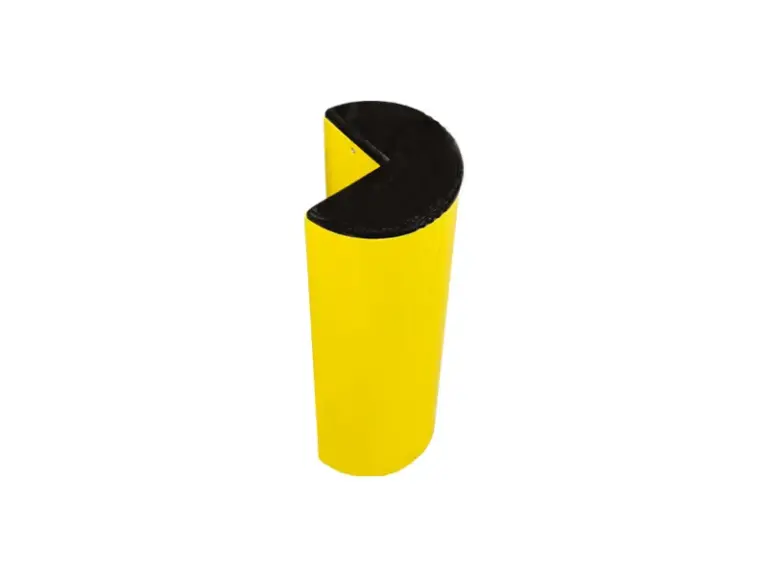
How polymer corner protectors work
Polymer corner protectors are installed at the corners and ends of racking systems, where uprights are most exposed during manoeuvres. In the event of accidental contact, the protector acts as the first point of contact with the material-handling equipment, preventing direct impact on the load-bearing structure.
The polymer material is designed to absorb and disperse some of the impact energy, helping to reduce the forces transferred to the upright. This provides a protective barrier for the most vulnerable areas of the racking during material-handling operations.
Design and fixing of polymer corner protectors
Polymer corner protectors are manufactured using materials and designs intended to withstand the forces generated by accidental impacts and the demands of warehouse environments. Their mechanical properties and impact performance vary depending on the polymer used, the protector’s geometry and its construction. The appropriate solution should therefore be selected according to the operating conditions and the expected level of impact exposure in the area to be protected.
The protector is anchored to the floor using the fixing method specified for the model and may be available in different sizes to suit the racking uprights and the available manoeuvring space. Before installation, compatibility with the racking and floor must be verified, taking into account any space constraints or obstacles in the material-handling area.
Benefits of polymer corner protectors
In addition to protecting racking uprights from accidental impacts, polymer corner protectors offer several benefits for day-to-day warehouse operations:
- Polymer materials do not rust and can be suitable for humid environments and other demanding operating conditions, depending on the specific product.
- High-visibility colours make racking ends easier to identify, helping operators recognise areas that require extra care when manoeuvring.
- Depending on the model, some protectors can be installed without being directly anchored to the floor, simplifying installation and any subsequent maintenance work.
- Different models and sizes are available to suit various racking upright types.
Applications of polymer corner protectors
Polymer corner protectors can be fitted to racking in areas where the risk of accidental contact with material-handling equipment is highest. Their use depends on the aisle layout, available manoeuvring space and warehouse traffic flows. They may be particularly useful in the following situations:
- At the ends of racking rows, particularly where forklifts frequently enter or exit aisles.
- At aisle junctions and intersections, where converging traffic routes can require complex manoeuvres and increase the risk of impacts to racking uprights.
- In areas near loading and unloading bays, where handling operations are frequent and multiple vehicles and operators are present.
- In warehouses with narrow aisles or limited manoeuvring space, where clearance between material-handling equipment and the racking may be particularly tight.
Racking safety standards
UNI EN 15635 provides guidance on managing the risk of racking damage and the use of protective devices. It is the reference standard for the use and maintenance of static steel storage systems and includes passive protection as one of the measures for reducing the risk of structural damage in areas particularly exposed to impacts from material-handling equipment.
The installation and proper maintenance of protective devices also fall within the broader framework of Italian Legislative Decree 81/2008. In particular, Article 71 requires work equipment to be suitable for its intended use and appropriate for the work to be carried out. It also requires the necessary measures to be taken to ensure that equipment is installed and used in accordance with the manufacturer’s instructions and properly maintained, so that the required safety conditions are preserved over time.
Custom-Designed polymer corner protectors
Every warehouse has its own layout and operating conditions. On request, we assess the racking configuration, aisle layout and material-handling flows to identify areas where protection may be appropriate. The most suitable device is selected based on the upright configuration, available space and handling operations, ensuring compatibility with the existing layout and the specific operational requirements of the warehouse.
FAQ
They are particularly suitable for areas exposed to frequent material-handling traffic, such as the ends of racking rows, aisle intersections and areas near loading and unloading bays. The areas to be protected should be identified based on the warehouse layout and material-handling flows.
They mainly require periodic visual inspections to check their condition and ensure they remain correctly positioned. If the protector is damaged, deformed or deteriorated following an impact, it should be assessed and replaced if necessary.
Installation requirements vary depending on the protector model. Some polymer protectors can be installed without floor anchoring, while others require specific fixing systems. Neither building work nor welding to the racking is required.
No. Corner protectors are an additional measure for managing impact risks and do not replace other measures required to maintain warehouse safety. They should be used alongside proper aisle layout, effective material-handling traffic management, appropriate signage and operator training.