


Light-duty mobile racking: a manual solution for maximising storage space
Light-duty mobile racking is a manually operated storage system designed for light loads. Unlike fixed racking, the units are mounted on mobile bases that run along rails installed in the floor. The access aisles are therefore not permanently fixed, but can be opened wherever and whenever access to the stored goods is required. This creates a compact storage layout in which a single access aisle provides access to all the storage bays within the system.
This solution is particularly suited to environments where goods are loaded and retrieved manually and only accessed occasionally, such as document archives, production areas, spare parts stores and technical rooms. Its modular design allows the system to be configured according to the type of goods being stored, access frequency and available space, while maintaining the required levels of safety and stability for light-duty metal racking.
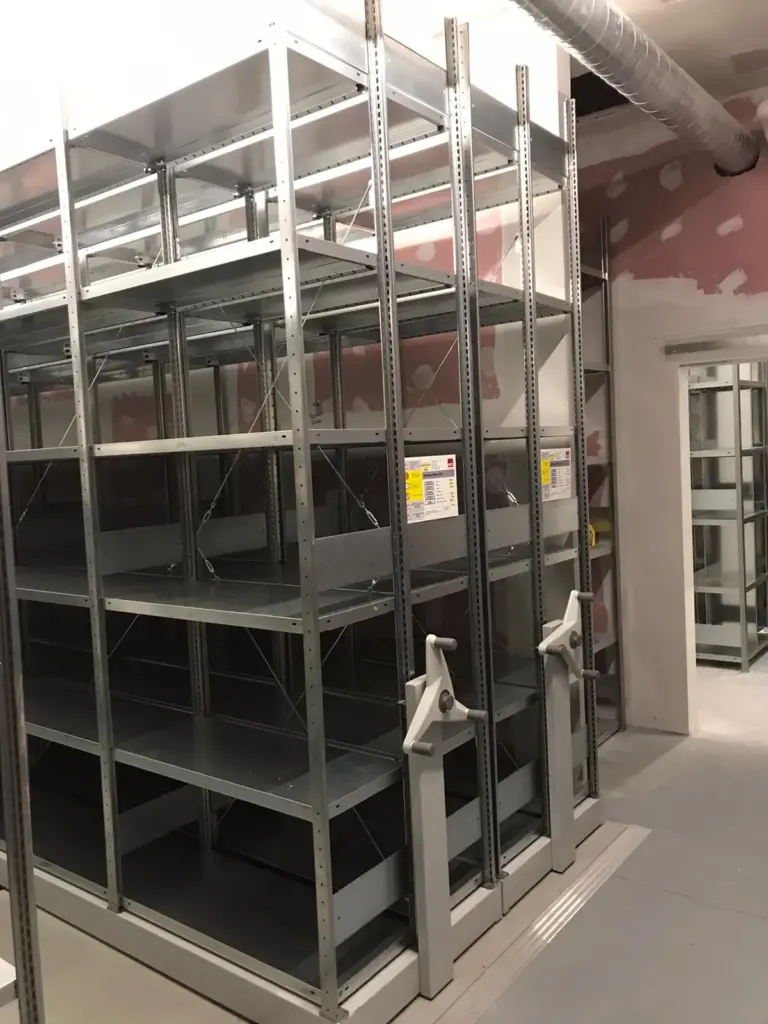
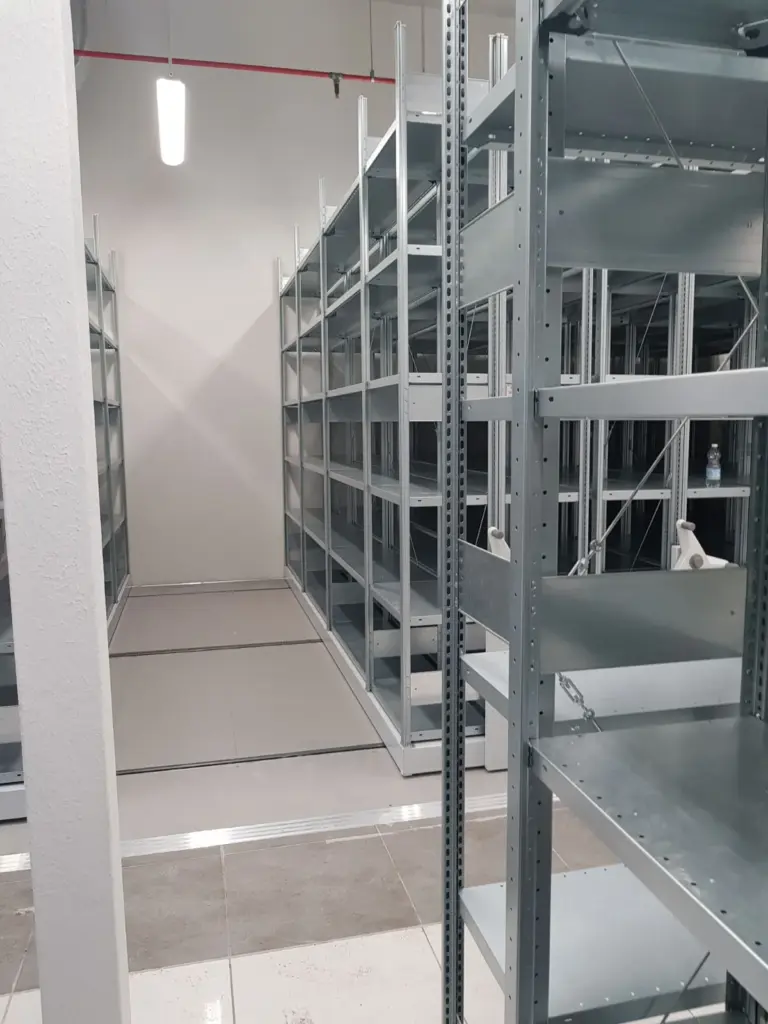
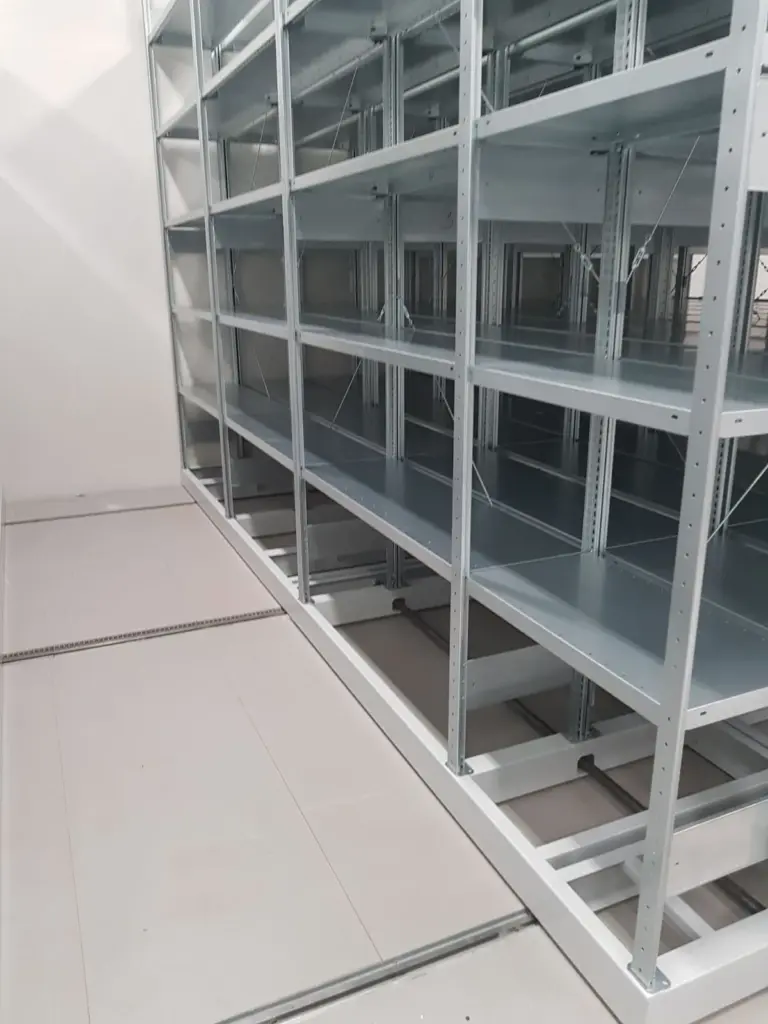
How light-duty mobile racking works
The racking units are mounted on mobile bases that run along floor-mounted rails and are operated manually using a crank or handwheel connected to the base wheels through a chain or gear mechanism. Turning the handwheel moves the mobile base along the rails, opening an access aisle at the required bay without the need for electric motors. This straightforward operating principle makes the system easy to use while keeping operating and maintenance costs low, and allows it to be installed in areas where no dedicated power supply is available for the mobile bases.
Increased usable storage space
By eliminating fixed aisles between the racking units, light-duty mobile racking makes more of the available floor space usable for storage than a conventional fixed layout. Depending on the size of the area, the number of mobile bases and the system configuration, storage space can be increased by up to approximately 80–85%. This means that, within the same footprint, the system can provide greater storage capacity or, where the storage requirement remains unchanged, free up floor space for other activities.
Applications of light-duty mobile racking
Light-duty mobile racking is suitable for storing boxes, containers, archive files, technical and administrative documents, production components and small parts. It can therefore be used in a wide range of settings, including offices and archives handling large volumes of documentation with occasional access, production areas where components and consumables need to be kept close to workstations, and spare parts stores with a high number of low-turnover SKUs. In all these applications, opening only the aisle required provides a more organised layout and reduces the time needed to locate stored items.
Technical features and components of light-duty mobile racking
The system features steel uprights and beams with height-adjustable sheet metal shelves, allowing the storage space to be adapted to containers and materials of different sizes. The mobile bases run on guide wheels and are operated by a manual drive mechanism, enabling smooth and controlled movement along the floor-mounted rails.
- Modular steel structure with height-adjustable shelves
- Mobile bases running on floor-mounted rails, manually operated by a crank or handwheel
- Safety mechanisms that prevent the mobile bases from moving unintentionally while the access aisle is in use
- Configurable to suit load dimensions, access frequency and the available space
Safety and applicable standards for light-duty mobile racking
Manually operated light-duty mobile racking falls within the scope of UNI EN 15635, which covers the use and maintenance of steel static storage systems, including periodic inspections and the proper management of unit loads. As the system is not motorised, its mobile bases are not subject to the Machinery Directive 2006/42/EC. CE marking is therefore not required for the manually operated system, although safety mechanisms must be provided to prevent the bases from moving unintentionally while an operator is inside the open aisle. Correct installation, secure floor anchoring and regular visual inspections are essential to maintain the safety of the system over time.
Custom design for your light-duty mobile racking
Each warehouse environment has its own requirements in terms of available floor space, the type of materials to be stored and how frequently they need to be accessed. A technical site survey allows the system to be configured accordingly, from the number of mobile bases and bay dimensions to the shelf layout, maximising storage capacity while maintaining efficient day-to-day operations.
FAQ
The racking is installed on mobile bases that run along floor-mounted rails. The operator opens an access aisle to the required bay by turning a hand crank or wheel connected to the base, with no electric drive required.
By eliminating fixed aisles, a mobile racking system can typically increase the floor area available for storage by up to 80–85% compared with a conventional static configuration. The actual space saving depends on the dimensions and layout of the facility, the number of mobile bases and the system configuration.
No. As the system has no motorised drive, the mobile bases do not fall within the scope of the Machinery Directive 2006/42/EC, unlike motorised mobile racking systems. Safety devices are nevertheless required to prevent unintended movement while the access aisle is in use.
They are suitable for document archives, technical offices, spare parts stores and production areas where boxes, containers, documents or lightweight components need to be stored and accessed manually, but only occasionally.