

What is gravity flow racking?
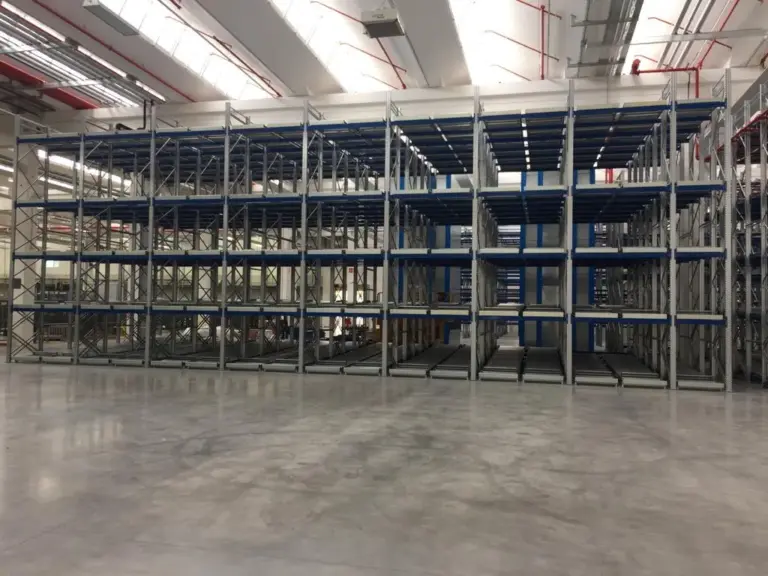
Gravity flow racking, also known as flow rack, is a pallet storage system in which pallets move along slightly inclined roller lanes under the force of gravity, without the need for powered handling equipment within the storage channels. In the most common configuration, with separate loading and unloading faces, the system operates according to the FIFO (First In, First Out) principle: the first pallet loaded into a channel is the first to be retrieved. This ensures consistent and controlled stock rotation.
Gravity flow racking is particularly suitable for warehouses where product rotation is critical, such as when handling goods with expiry dates, production batches or traceability requirements.
Pallets are loaded at the rear of the rack and move automatically towards the picking face along inclined roller lanes, propelled solely by gravity. The slope of each channel is determined during the design stage according to the load weight and channel length. Brake rollers and speed regulators positioned along the lanes control pallet speed, ensuring smooth movement and preventing pallets from colliding.
For the system to operate correctly, the pallet base must be suitable for roller conveyance, and the load must be evenly distributed across the pallet.
FIFO configuration and reverse-slope variant
With separate loading and unloading faces, the system follows the FIFO principle described above, making it particularly suitable where effective stock rotation is essential. An alternative reverse-slope configuration allows both loading and retrieval from the same operating face. This arrangement follows the LIFO (Last In, First Out) principle and is suitable where stock rotation is less critical, while reducing the number of operating faces required.
Technical features and components of gravity flow racking
The system features a load-bearing structure similar to that of conventional pallet racking, with inclined roller lanes integrated into the rack. Its main components include:
- Roller lanes, designed according to the pallet type, load weight and number of pallets to be stored in each lane.
- Brake rollers and speed regulators, which control pallet movement and prevent uncontrolled acceleration.
- Entry and exit guides, which facilitate forklift manoeuvring during loading and retrieval.
- The modular structure can be adapted to different warehouse heights and configured for integration with automated handling systems, including AGVs and LGVs.
The design and specification of gravity flow racking, including its components and dimensional tolerances, as well as inspection and maintenance procedures, are covered by the relevant technical standards, including UNI EN 15629, UNI EN 15620 and UNI EN 15635.
Benefits of gravity flow racking
- Maximised use of available warehouse space by eliminating the intermediate aisles required for conventional selective pallet racking.
- Each channel is dedicated to a single SKU, with multiple channels arranged side by side across different levels. This layout makes products easier to locate and helps reduce picking times.
- FIFO stock rotation in configurations with separate loading and unloading faces.
- Reduced forklift travel time by separating the loading and picking faces.
- Reduced energy consumption in temperature-controlled warehouses, as higher storage density means less overall volume needs to be conditioned.
Applications of gravity flow racking
Gravity flow racking is particularly suited to warehouses handling homogeneous, fast-moving goods with expiry-date or batch-traceability requirements, such as those in the food and beverage, pharmaceutical and retail sectors, as well as batch manufacturing. It is also an effective solution for linking production and shipping areas, maintaining a continuous flow of goods between the two stages of the logistics process.
Custom design of gravity flow racking
The modular design of gravity flow racking allows each system to be configured to suit pallet dimensions, load weights and the specific operational requirements of the warehouse. The design process begins with an assessment of the operating conditions, including the type and weight of load units, available installation height, structural constraints of the building and required material flows. Channels, roller tracks and braking devices are then sized in accordance with the applicable UNI EN standards and, where required, seismic design criteria.
FAQ
Gravity flow racking uses inclined roller tracks to move pallets through the storage lanes by gravity, without mobile carts or frames. In the most common configuration, pallets are loaded from one side and retrieved from the opposite side, following a FIFO (First In, First Out) principle. Push-back racking, by contrast, uses carts running on inclined rails. When a new pallet is loaded, the forklift pushes the pallets already in the lane towards the back, while both loading and retrieval take place from the same side, following a LIFO (Last In, First Out) principle.
Standard counterbalance or reach trucks are generally suitable for gravity flow racking, as pallets are loaded and retrieved from the front of each storage lane. The forklift does not need to enter the racking structure, unlike with Drive-in racking, where the truck operates inside the storage lanes.
Yes. The high storage density reduces the overall volume that needs to be temperature-controlled compared with conventional storage systems, helping to improve the efficiency of refrigerated warehouses. This makes gravity flow racking particularly suitable for food and pharmaceutical applications where strict FIFO stock rotation is required.
The structural design and sizing of gravity flow racking are governed by UNI EN 15629 and UNI EN 15620, while UNI EN 15635 covers the use, maintenance and periodic inspection of the racking system.