

Why is it time to rethink just-in-time logistics?
For decades, just-in-time (JIT) logistics has been a key strategy for businesses seeking to reduce operating costs while maintaining production capacity. The approach is based on producing goods and replenishing stock in line with actual market demand, minimising the capital tied up in inventory and reducing the costs associated with excess stock and product obsolescence.
However, recent events, including global pandemics, geopolitical tensions, rising energy costs and disruptions to major trade routes, have called into question a long-held assumption: that extended, highly streamlined supply chains can be relied upon to operate without interruption. Instead, these developments have exposed their vulnerability to external shocks.
In today’s market, inflation and raw material shortages make accurate forecasting increasingly challenging. This leaves every supply chain manager facing a crucial question: is just-in-time (JIT) logistics still a viable approach, or is the model becoming obsolete?
Just in Time vs Just in Case
In response to growing global uncertainty, many businesses are moving away from a strict just-in-time (JIT) approach and adopting just-in-case (JIC) inventory management instead. This strategy involves holding safety stock or buffer inventory to reduce the risk of supply shortages when unexpected disruptions occur.
What are the key differences between the two approaches?
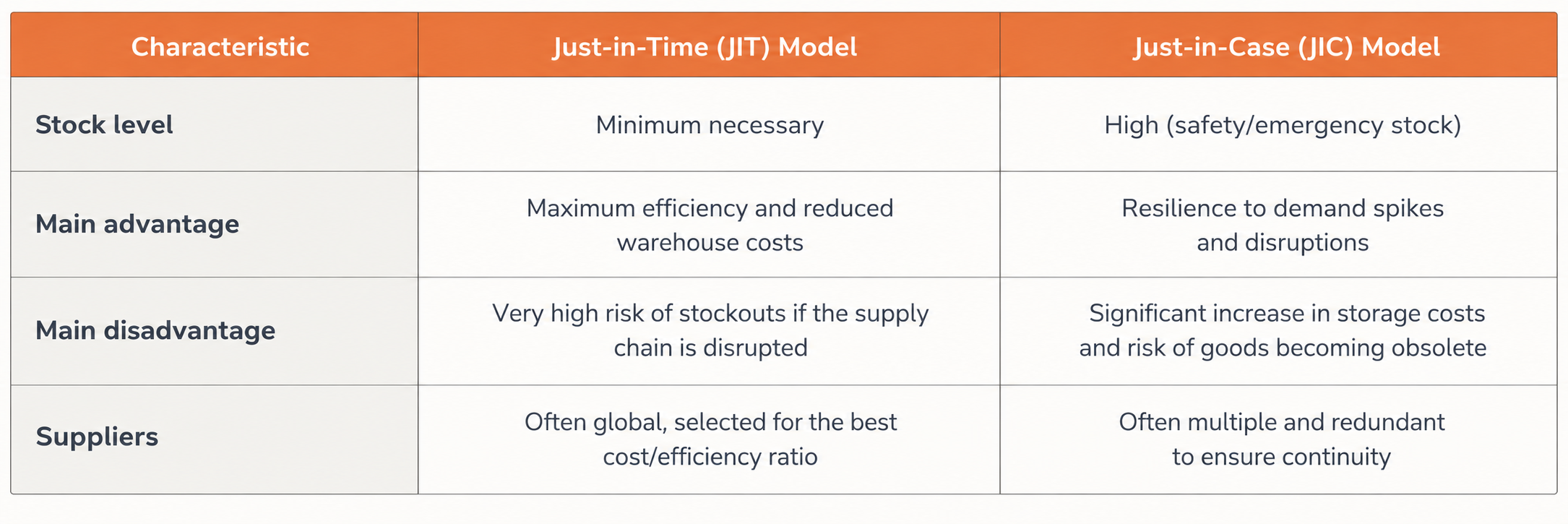
Neither approach is a clear-cut winner. While just-in-case inventory management provides a buffer against supply disruptions, it can tie up working capital in stock sitting idle on warehouse shelves, putting pressure on a company’s cash flow.
Nearshoring and hybrid supply chains: a practical solution to stock-out risk
Industry experts agree that the way forward lies in finding the right balance between the two approaches. To preserve the cost efficiency and flexibility of just-in-time (JIT) logistics while minimising the risk of global supply chain disruptions, businesses are adopting three key strategies:
Nearshoring
Until a decade ago, nearshoring was a relatively low priority for many businesses. Globalisation favoured increasingly distant suppliers, ocean freight was competitively priced, and sourcing from Asia seemed a cost-effective way to reduce unit production costs. Then came a series of major disruptions: the COVID-19 pandemic, the blockage of the Suez Canal, the semiconductor shortage in the automotive industry and the war in Ukraine.
Lean production principles suggest keeping critical suppliers within an ideal radius of 200 kilometres, and this is no arbitrary threshold. At this distance, lead times can be reduced to hours or a few days rather than weeks, while transport costs decrease significantly. Sourcing closer to home also reduces exposure to customs duties and exchange rate fluctuations. Just as importantly, it enables closer collaboration with suppliers and faster responses when disruptions occur.
For Italian businesses, this has led to growing interest in sourcing from Eastern Europe, the Mediterranean region and North Africa. Although some raw materials and components can only be sourced or manufactured in specific parts of the world, identifying which purchasing categories can be sourced closer to home helps reduce exposure to global supply chain disruptions. Unit costs may be slightly higher, but the overall cost can often be lower once reduced safety stock requirements, shorter lead times and a lower risk of supply interruptions are factored in.
Diversifying supply sources
After experiencing a stock-out, businesses may be tempted to increase the number of suppliers they work with. The principle is sound, but implementation often falls short: having a potential backup supplier is very different from having an alternative supplier that is fully qualified and ready to step in at short notice.
Effective supplier diversification requires a structured approach across three distinct levels.
- The first step is to qualify alternative suppliers in advance. Each backup supplier should be assessed and approved before a disruption occurs, through supplier audits, sample testing and compliance checks carried out well ahead of time.
- The second is geographical diversification. Having two suppliers is not enough if both are based in the same country or geopolitically unstable region. Effective diversification also requires spreading supply sources across different locations and actively identifying areas where risks are concentrated.
- The third is to maintain strong, ongoing relationships with secondary suppliers. A supplier that has not received an order for months is unlikely to prioritise your business when demand suddenly increases. Placing regular orders, even for small quantities, helps keep these relationships active and strengthens supply chain resilience.
It is also worth distinguishing between dual sourcing, which involves splitting order volumes between two suppliers (typically on a 70/30 or 80/20 basis), and multi-sourcing, which expands the supplier base further but increases management complexity. The right approach depends on the component’s volume and criticality, but the underlying principle remains the same.
Predictive technology
By the time a supply chain disruption becomes visible through empty shelves, unfulfilled orders or halted production lines, it is already too late to intervene without incurring losses. Effective modern supply chain management is not about reacting quickly, but about anticipating problems before they arise. This is where predictive technology comes into play.
Predictive technology provides real-time visibility into actual stock levels, the status of outstanding orders and changes in demand. Integrating a Warehouse Management System (WMS) with the company’s ERP system helps maintain an accurate, up-to-date view of warehouse operations, reducing blind spots that can turn unexpected events into supply chain crises.
The next step is demand forecasting. By analysing historical order data, seasonal trends, supplier lead times and market signals, forecasting models help determine the optimal reorder point in advance, enabling businesses to replenish stock before shortages occur.
However, technology is only as effective as the warehouse operations that support it. Implementing an advanced tracking system in a warehouse with unmapped racking, inconsistent goods-in and goods-out procedures or an inefficient layout will compromise data reliability. Accurate data depends on well-defined, properly managed processes at the operational level.
When strategy changes, the warehouse must adapt.
Choosing between just-in-time, just-in-case or a hybrid model has tangible implications for the entire warehouse ecosystem.
Companies that increase safety stock to protect against supply chain disruptions may find their racking under greater strain, aisles becoming congested and picking operations slowing down. By contrast, businesses that retain a just-in-time approach for high-turnover product categories need a warehouse layout that minimises picking times, with fast-moving items positioned for easy, ergonomic access.
In either case, a warehouse layout that no longer supports the current storage strategy can become a significant operational bottleneck.
Safety is often overlooked during periods of operational change. As warehouse flows evolve, so do the loads placed on racking, the way aisles are used and the working practices of operators. The storage system must therefore be assessed against actual operating conditions to ensure it continues to meet applicable requirements, rather than relying on the assumptions made when it was originally designed.
Don’t wait for a crisis to optimise your warehouse.
If you’re reviewing your logistics strategy or assessing whether your warehouse can accommodate changing operational demands, the first step isn’t to invest in new racking or replace your software. It’s to evaluate your existing setup and identify where improvements are needed.
Di Massa helps businesses adapt their warehouses to changing logistics requirements through warehouse flow analysis, racking compliance assessments based on actual operating conditions, and layout optimisation aligned with their storage strategy.
Contact us today to assess your warehouse in its current state and identify the changes needed to keep pace with evolving market demands, before they force your hand.